
Buying & Sourcing Guide
24V LED Headlight Bulbs for Trucks: What Fleet Buyers and Truck Workshops Should Check Before Ordering
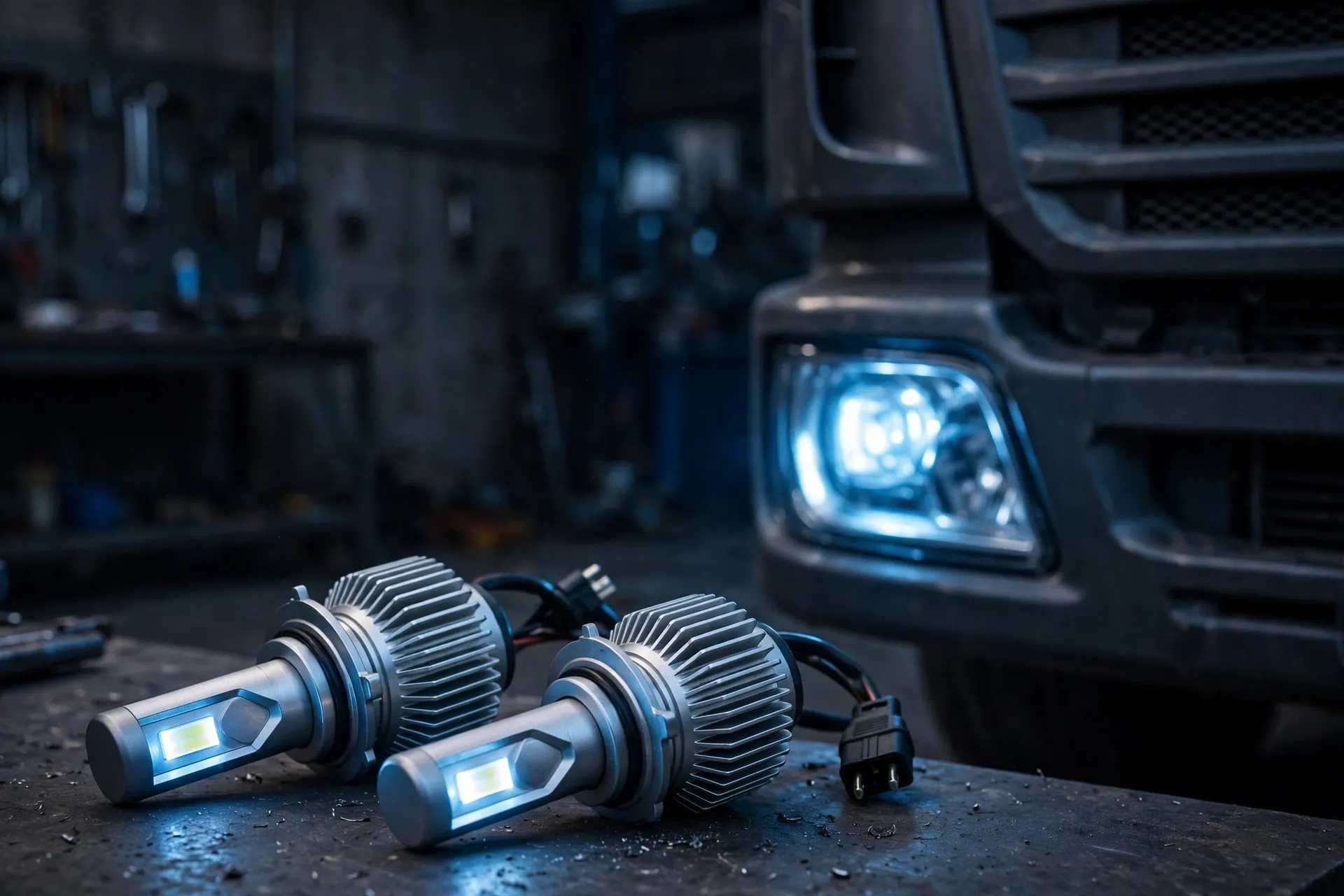
24V LED Headlight Bulbs for Trucks: What Fleet Buyers and Truck Workshops Should Check Before Ordering
Take a typical scenario: a truck workshop fits a set of LED headlight bulbs that worked fine in the customer's cars. A week later the truck is back. One bulb flickers when the engine is under load, the other has gone dim. The driver lost a night run, the workshop lost half a day of bay time, and now somebody has to explain who pays for the replacement. The bulbs were not defective. They were 12V bulbs in a 24V truck.
That is the mistake this guide exists to prevent. Most heavy trucks, buses and many commercial vehicles run on 24V electrical systems. A bulb built only for 12V can overheat or fail early on a 24V system, and a cheap driver can flicker when the alternator voltage moves around under load. If you buy for a fleet, a truck workshop, or a mixed customer base of cars and trucks, these checks matter. They decide whether your LED stock earns repeat orders or generates warranty claims.
1. Why a 24V Truck Punishes the Wrong Bulb
A passenger car and a heavy truck do not ask the same thing from a headlight bulb, even when the socket looks identical.
First, the voltage is different. A 12V car's system runs around 12 to 14 volts. A 24V truck's system runs around 24 to 28 volts, and the alternator output moves up and down with engine load. A bulb whose driver was designed for a 12V range can be pushed past its limits the moment it is fitted to a truck. The failure is rarely instant. It shows up a week or a month later as flicker, dimming, or a dead bulb — exactly the kind of failure a customer blames on quality, not on the wrong voltage.
Second, trucks work longer hours. A delivery truck or a long-haul tractor can run its headlights for ten hours or more in a single shift, night after night. Heat builds up over those hours in a way a short evening commute never tests. A cooling design that survives a car can struggle in a truck that never really cools down.
Third, vibration is constant. Rough roads, loaded trailers and diesel engines shake everything in the headlight housing, hour after hour. A fan with a bearing is a moving part, and moving parts are the first thing vibration attacks. A fan that starts to wobble can get noisy, slow down, and stop — and a bulb that loses its cooling does not last long after that.
Fourth, downtime costs more than the bulb. When a car bulb fails, the owner drives to a shop. When a truck bulb fails, a vehicle that earns money by moving is parked, a driver is idle, and a delivery is late. For a fleet buyer, the price of the bulb is the smallest number in the calculation. The expensive number is the truck standing still.
2. Check One: The Voltage Range Must Be Written Down
This is the single check that matters most, and it is also the easiest to get wrong. Do not accept "12V/24V" as a spoken promise from a sales chat. Ask for the input voltage range printed on the spec sheet — for example, DC 9–30V — and keep that spec sheet with your order.
A documented wide-voltage input means one SKU can cover both your 12V car customers and your 24V truck customers. That keeps your stock levels lower and removes the most common mix-up in the warehouse. But the range has to be real. If the spec sheet only lists 12V, the bulb is a car bulb, no matter what the listing title says.
Two practical rules follow from this:
- Put the voltage version on every line of your purchase order, and ask for the carton label to show it. If a supplier sells the same model in a 12V version and a 24V version, mixing the two in one shipment without clear labels is the fastest way to get warranty claims. Your warehouse team should be able to tell the versions apart without opening a box.
- Read the range per socket, not per product family — and check whether the stated range covers every socket the model is sold in.
The K9 is one example from our own range. Its spec sheet lists DC 9–30V input, 60W and 6,500 lumens, which is why it is stocked for both cars and 24V trucks. Check the range against the socket you are ordering. The H4 Mini Projector Bulb is listed for 12V/24V operation at 120W. In both cases, the point is the same: the voltage range is a printed specification, not a sales claim. For other models in our range, including the HT and HTD series, 24V suitability is confirmed per model on the spec sheet — ask for it in writing with your quote.
3. Check Two: Confirm the Socket and the CANbus Need for Each Truck Model
Truck headlights use the same socket names as cars — H7, H11, 9005, 9006, H4 — but that does not mean any bulb with the right socket will work. Two trucks with the same socket can behave differently, and the difference shows up after installation.
Start with the bulb that came out of the housing. Read the number printed on its base, and confirm it against the owner's manual or a fitment chart for the exact year, make, model and trim. Our bulb-size guide walks through the most confused pairs — the same discipline applies to trucks: the socket code decides, not the shape in the photo.
Then check the truck's electrical behavior. Modern trucks monitor their lighting circuits, and some use PWM (pulsed power) and reduced-voltage daytime running light (DRL) operation. After an LED conversion, that can show up as flicker, a bulb-out warning, intermittent operation, or one side switching off. These symptoms do not all have the same cause, and a decoder is not the automatic answer — first confirm whether the truck monitors the circuit at all, and what its DRL mode actually does. Our CANbus decoder guide explains when an external decoder is needed. CANbus is the system that monitors the bulbs, and our HT series uses an external decoder driver while the HTD series carries a built-in driver. For trucks, the question to ask your supplier is simple: "For this truck model, does the bulb need a decoder, and is it built in or external?"
4. Check Three: Cooling That Survives Vibration and Long Hours
Cooling is where truck use separates good bulbs from short-lived ones. There are two honest designs, and each has a place:
- Fan-cooled bulbs move air actively and can be compact, which helps in tight housings. But the fan is a moving part, and on a truck that vibrates all day, a fan's bearing life becomes a real question. Ask how the fan is protected and what happens to the bulb if the fan slows down.
- Fanless bulbs use a large aluminum heat sink instead of a fan. Nothing moves, so there is nothing for vibration to wear out. The trade-off is size: the heat sink needs space behind the housing, and the dust cover must still close without pressing on it.
Our K9 takes the fanless route: a 6063 aluminum heat sink with no fan, a 360° beam, and a DC 9–30V input, which is the combination we point truck buyers to when the housing has room for the heat sink. Our fan vs fanless comparison explains the trade-off in full — the right answer depends on the housing, not on which design sounds newer.
Whichever cooling design you choose, measure the space behind the housing before you order in volume. An LED bulb can have the correct socket and still be a poor physical fit. Fans, heat sinks, external drivers and decoders all need usable space, and the factory dust cover should go back on without crushing wires or pressing against the cooling system. A bulb that forces the dust cover off will let moisture and dust into the housing, and the next failure will be blamed on the bulb.
5. Check Four: Read the Spec Sheet Like a Warranty Claim Is Coming
A spec sheet is a promise. Before you place a fleet order, read it the way you would read it after a failure, when you need the supplier to stand behind it.
- Input voltage range — printed, per socket, as in Check One.
- Real power and real output — ask whether the number is per bulb or per pair, and whether it is measured or rounded up. Headline numbers on a listing tell you nothing about how the bulb behaves on a truck: an inflated lifetime-hours claim on a retail listing is not a test result, and it is not a warranty. What matters is the warranty itself — ours is 18 months, in writing — and whether the supplier will honor it when a truck bulb fails in month eight.
- Beam pattern, not brightness — a bulb that looks extremely bright from the front can still produce glare, dark spots, or a scattered beam on the road. The emitters must sit close to the original filament position so the housing shapes the light correctly. Our beam-pattern guide shows how to check the cutoff line on a wall before a bulb goes out to a fleet.
- What the warranty covers, and what it does not — does it cover the driver as well as the bulb? Does it cover failures caused by voltage outside the stated range? Get the answers in writing before the first order, not after the first claim.
A supplier who cannot produce a spec sheet, a test report, or a written warranty term is not a supplier for a fleet order. Our supplier-vetting checklist gives you the ten questions to ask before any first order, and they apply double to truck volumes.
6. Stocking Plan: One SKU or Two Versions?
If you serve both cars and trucks, you have a stocking decision to make, and both answers can work:
- One wide-voltage SKU for both. If a model genuinely covers 9–30V, one part number serves both markets. Stock stays simple, and the warehouse cannot mix up versions because there is only one version. This works best when the model also covers the sockets your customers actually use.
- Separate 12V and 24V versions, clearly labeled. Some high-output models are sold in two versions for a reason, and the 24V version may have a different driver tune. If you stock both, the discipline is in the labeling: version on every purchase-order line, version on the carton, and separate shelf positions. A mixed shipment with no labels will produce a claim sooner or later.
Whichever option you choose, do not roll a new bulb out to a whole fleet at once. Fit one truck first. Drive it for two weeks — night runs, loaded, in the rain if you can. Check for flicker under load, check the beam pattern on a wall, check that the dust cover stayed on and the housing stayed dry. If the trial truck is clean after two weeks, the first bulk order is safe to roll out. If it is not, you have found the problem on one truck instead of forty.
Our early-failure guide explains the four usual causes — an undersized heat sink, a worn fan, a cheap driver, and heat with nowhere to go at the mounting position — and the trial fit is how you catch them before they become forty warranty claims.
7. What to Ask Before You Order (Copy This List)
Send this to any supplier before a first truck order, and keep the written answers with the order:
- What is the documented input voltage range, per socket?
- Which truck models has this bulb been fitted to, and was a decoder needed?
- Is the driver built in or external, and what happens if the fan stops (for fan-cooled models)?
- What is the warranty period, what does it cover, and what proof do you need for a claim?
- Can I buy a sample set first, and does the sample price count toward the first bulk order?
- What is the lead time for my quantity, and what is the minimum order for neutral color boxes versus printed logo boxes?
For SUNRISE, here is what is fixed: 18-month warranty; in-stock orders from 50 sets in neutral color boxes, logo printing free from 100 sets, custom color boxes from 1,000 sets (+ $0.50 per set); T/T (bank transfer) 30% deposit and 70% before shipment; in-stock orders ship within one week, and orders without stock ship 20–30 days after the deposit. Three things are confirmed in writing with your quote, because they depend on the model and the quantity: whether a sample set's price counts toward the first bulk order, what documents a warranty claim needs, and whether a given truck model needs a decoder. Custom-box lead times are agreed in writing before the order. For anything the spec sheet does not state, the quote is the document that counts — ask, and get it in writing.
FAQ
Q1: Can I use the same LED bulbs in my 12V cars and 24V trucks?
Only if the spec sheet lists a wide input range that covers both — for example DC 9–30V. A 12V-only bulb fitted to a 24V truck can overheat or fail early. Check the printed range per socket, not the listing title.
Q2: Do truck LED bulbs need a CANbus decoder?
It depends on the truck. Some trucks monitor the lighting circuit or run reduced-voltage DRL, which can cause flicker or bulb-out warnings after a conversion. Confirm the truck's behavior first; a decoder is needed only when the truck actually monitors the circuit. Our HT series uses an external decoder driver, while the HTD series carries a built-in driver.
Q3: Is a fanless bulb better for trucks?
For trucks, fanless has a real advantage: no moving fan means nothing for vibration to wear out, and no fan noise. The trade-off is size — the heat sink needs room behind the housing, and the dust cover must still close. Measure the space before ordering.
Q4: What is the minimum order for a first truck order?
In-stock orders start at 50 sets in neutral color boxes, so a workshop can trial a model without a large commitment. Logo printing is free from 100 sets, and custom color boxes start at 1,000 sets.
Q5: Can I get samples before ordering for a fleet?
Yes — order a sample set, fit one truck, and run it for two weeks before rolling out to the fleet. Ask for the sample terms and the lead time in writing with your quote.
Q6: What should I do if a bulb flickers on a truck?
First confirm the cause: check the voltage range on the spec sheet, check whether the truck uses PWM or reduced-voltage DRL operation, and check the connections. Our flickering guide walks through the seven most common causes and fixes. If the bulb is within its stated voltage range and still flickers, contact the supplier with the truck model and the symptoms — that is what the warranty is for.
Q7: How long does delivery take?
In-stock orders ship within one week. Orders without stock ship 20–30 days after the deposit. Custom-box orders have their lead time agreed in writing before the order.
The Bottom Line
Truck buyers do not need the brightest bulb on the listing. They need a bulb whose voltage range is printed on a spec sheet, whose cooling survives vibration and ten-hour nights, whose socket and decoder need were checked per truck model, and whose warranty is in writing. Get those four things right, trial-fit one truck, and the fleet order takes care of itself.
Send us your truck models and the sockets you need — or the model list you are quoting for a fleet — and we will confirm the voltage range, the decoder need and the price for a sample set and a first order.