
Buying & Sourcing Guide
H11 vs 9005 vs 9006 vs 9012: The Bulb-Size Map That Decides Your Returns
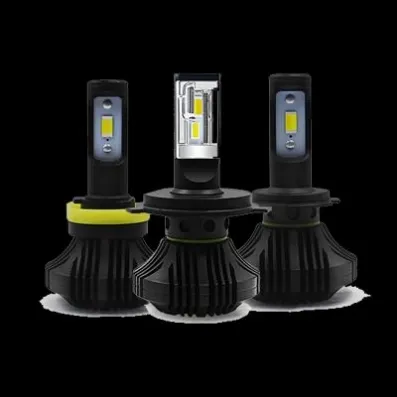
Take a typical scenario: a distributor orders 500 sets of LED headlight bulbs for the North American market, the cartons arrive, and the first workshop calls back the same week — half the bulbs will not lock into the housings they were sold for. The bulbs are not faulty. The beam pattern is not the problem. The size is wrong: 9005 went where 9006 belonged, and 9012 went where 9006 belonged. The returned bulbs come back in opened boxes, and an opened LED bulb is not a resellable unit — it is a loss, a complaint, and a customer who now buys from someone else.
This is the most expensive beginner mistake in the LED headlight trade, and it has nothing to do with brightness or price. Bulb size is a keyed mechanical part. The base decides whether the bulb locks in, the connector decides whether it plugs in, and the reflector decides where the beam lands. Get the base wrong and nothing else about the bulb matters. This guide gives you the size map, the three mix-ups that cause most returns, a stocking ladder by market, and a three-step check you can run before any order ships.
The Size Map: Five Bases Cover Most of Your Orders
Most cars on the road use one of about fifteen halogen bulb types, but five bases cover the large majority of retrofit orders a distributor will see. Learn these five first, and learn them by base code — not by how the bulb looks, because several of them look almost identical on a bench.
Bulb | Also called | Base code | Filaments | Halogen rating | Typical role |
|---|---|---|---|---|---|
H11 | — | PGJ19-2 | 1 | 55 W | Low beam, fog light |
9005 | HB3 | P20d | 1 | 60 W | High beam |
9006 | HB4 | P22d | 1 | 51 W | Low beam, fog light |
9012 | HIR2 | PX22d | 1 | 55 W | Low beam, compact projector |
H7 | — | PX26d | 1 | 55 W | Low or high beam |
H4 | 9003, HB2 | P43t | 2 | 60/55 W | High + low in one bulb |
Two notes on the numbers in this table. First, halogen ratings follow the ECE R37 standard at 12 V; US catalogues often list higher figures because they rate at 12.8 V — a 9005 listed as 65 W and a 9006 listed as 55 W in a US catalogue are the same bulbs as the 60 W and 51 W figures above. Second, H4 is the exception in the list: it is a dual-filament bulb that does high and low beam in one unit, which is why it dominates markets where one bulb per side has to do everything.
The base code is the part that decides fit. Two bulbs with different base codes are different bulbs, even when the glass, the plug and the collar look the same. If your order sheet lists a bulb by its trade name only — "9005" written from memory, "H11" guessed from the car model — you have already created the conditions for a return. Write the base code on every line of every order.
Mix-Up No. 1: 9005 vs 9006 — Same Plug, Wrong Key
9005 and 9006 are the most confused pair in the American aftermarket, and the confusion is built into the parts themselves. Both are single-filament bulbs. Both use the same right-angle two-pin plug. Both sit in the same collar diameter. What separates them is the keying: the locking tabs on the plastic collar sit at different offsets, and the plug has a different internal rib. A 9005 will not lock into a 9006 socket, and a 9006 will not lock into a 9005 socket — unless someone forces it, in which case the tab breaks and the bulb seats rotated a few degrees off its designed position. From outside, the lamp looks fine. The beam does not.
The roles are fixed: 9005 (HB3, P20d) is the high beam; 9006 (HB4, P22d) is the low beam or fog light. A 9005 is not "a brighter 9006". It is aimed at a different height by the reflector, so a 9005 fitted in a low-beam housing throws light where oncoming drivers sit, and a 9006 fitted in a high-beam housing gives a low beam that stops short. Either way the driver concludes the bulbs are faulty — and the bulb comes back to you.
For a distributor the practical point is that these two travel together. The same car usually takes one of each: a 9005 high beam on one side of the housing and a 9006 low beam on the other, or an H11 low beam paired with a 9005 high beam — the H11-plus-9005 pairing is one of the most common two-bulb combinations on US-market Toyota, Ford, Chevrolet and Honda models. So a customer ordering "a set for my car" needs two different bases, and a single-SKU listing will not cover it. When you quote, quote the pair: one 9005 line and one 9006 line, each with its own base code, each in its own carton. A dealer who runs out of one half of a pair is a complaint that costs you a customer relationship, not a bulb.
Mix-Up No. 2: 9012 vs 9006 — The One That Fits Nothing It Looks Like
9012 (HIR2) is the quietest trap of the three. It shares a body, a plug and a general outline with 9006, and its base code — PX22d — differs from 9006's P22d by a single letter. That letter is the whole difference: the keyway stops a 9012 in a 9006 collar, and a 9006 does not belong in a 9012 housing either. 9012 was built as a higher-efficiency low beam for compact projector housings, mostly on Toyota, Scion, Dodge and some GM models. It is a low beam, 55 W, single filament — and it is not a 9006, whatever the shelf label says.
This mix-up is growing because 9012 demand is growing. It is one of the rising small sockets in the aftermarket, and the cars that take it are exactly the projector-equipped models that workshops see more of every year. The rule for your warehouse is simple: order 9012 on its own line, in its own bin, with its own label. Never file a keyway to make one of these fit another — the bulb will seat, it will not be indexed, and no amount of aiming will correct a beam that starts off-centre.
Mix-Up No. 3: H11 vs H8 vs H9 — One Family, Three Wattages
H11, H8 and H9 belong to the same PGJ19 base family and share the same L-shaped twist-lock. That is why catalogues list them together — and why they get mixed up. The difference is power: H11 is 55 W, H8 is 35 W, H9 is 65 W. They are the same shape, not the same bulb. H11 is the low beam and the most common fog light bulb in North America; H8 is usually a fog light; H9 is usually a high beam. Swapping them by shape alone puts the wrong wattage in the housing, and on an LED retrofit the driver and thermal design are matched to the bulb's intended role, so the mismatch shows up as flicker, error messages or early failure rather than as a bulb that simply will not fit.
The check here is the same as everywhere else in this guide: read the code stamped on the base of the bulb that came out of the car. H11, H8 and H9 are all stamped. None of them is stamped on the plug — and the plug is the part people check first, which is exactly why this mix-up keeps happening.
The Stocking Ladder: Which Sizes, in Which Market
A distributor does not need every size in equal depth. The mix follows the cars on the road in your market, and the mix is the decision that sets your volume, your SKU count and your return rate at the same time. Every extra base is another SKU, another label and another carton configuration — so the ladder below is about ordering depth, not about collecting sizes.
North America first. The US aftermarket runs on 9005 and 9006 as a pair, with H11 as the low beam and fog light standard. Stock 9005 deepest, then H11, then 9006 — and remember that 9006 demand is steady rather than growing, because the cars that use it are mostly older models, while 9012's share rises on projector-equipped models. Keep 9012 as a separate, growing line rather than folding it into the 9006 bin.
Europe next. H7 leads, because it is the low or high beam on most European and Korean cars — Volkswagen, BMW, Audi, Hyundai, Kia. H11 follows for SUVs and crossovers. European cars are also the ones most likely to need CANbus decoding, so a European size mix without a decoder option is an incomplete mix: German cars and many newer premium models monitor the circuit, and a plain bulb triggers a bulb-out warning on the dashboard.
Southeast Asia next. H4 dominates, because one dual-filament bulb does high and low beam in a single unit — the right answer for price-sensitive markets and for the motorcycle and small-car parc across the Philippines, Indonesia and Malaysia. H11 follows for newer Japanese models. In this market the mini projector H4 variants are also gaining ground, so the H4 line deserves a projector option alongside the standard bulb.
D-series: a separate shelf. D1S, D2S, D3S, D4S, D5S and D8S are a different system — HID replacement, not halogen replacement — and they belong on a separate shelf with their own rules. A D3S bulb must never be sold as a D1S: the ballast and connector are different, and mixing them damages the ballast. Keep the D-series away from the halogen size table entirely, and treat it as its own product family.
The Three-Step Check Before Anything Ships
A size guide only helps if it changes what happens before the carton leaves your warehouse. Put these three steps on the order form, and make them non-negotiable:
Step 1 — Read the stamp, not the catalogue. The bulb that came out of the car has its code stamped on the base: 9005 or HB3, 9006 or HB4, 9012 or HIR2, H11, H7, H4. If the code is worn off or unreadable, use the year, make and model in a vehicle bulb finder — never guess from the car's brand alone, because the same model can take different bulbs in different years and trims.
Step 2 — Match the base code, not the plug. The plug is the same on 9005, 9006 and 9012, and the collar diameter is the same on H11, H8 and H9. The base code — P20d, P22d, PX22d, PGJ19-2, PX26d, P43t — is the only thing that decides fit. Write it on the pick list, and have the packer check it against the carton label before sealing.
Step 3 — Test-fit one car per model before a bulk job. One bulb, one housing, one wall check: park about 7.5 metres from a wall and confirm the low-beam cut-off line is flat and horizontal, with no stray light above it. This catches the two failures a catalogue cannot — a dust cap that will not close over the bulb, and a housing whose tabs or depth differ from the standard. The ten minutes this takes are cheaper than a returned carton.
What to Stock: A Short SUNRISE Selection
If you are building a first size mix from SUNRISE, start from the models that cover the most sockets with the fewest SKUs. The K9 fanless bulb is the widest-coverage single model in the range: its published socket list covers H4/HB2, H13/9008, 9004, 9007, H1, H3, 880/881/H27, H10/9005/HB3, 9006/HB4, H7, H11/H8/H9 and H16EU/5202 — twelve-plus sockets from one fanless design, 60W, 6,500LM, DC 9–30V, with 3000K, 4300K and 6500K colour-temperature options. Because it has no fan, it also clears the dust-cap problem that stops many fan-cooled bulbs from fitting sealed housings. For the 9012 line, the HT8 Mini is the compact option built for tight projector housings. For the D-series shelf, the HTD series carries D-series replacements with the decoder built into the driver — while the HT series uses an external decoder driver, so the two lines are not interchangeable and should be quoted as such.
The commercial terms are the same across the range: 18-month warranty; in-stock orders from 50 sets in a neutral colour box; your logo printed free from 100 sets; a custom colour box from 1,000 sets at an additional $0.50 per set; payment by T/T, 30% deposit and 70% before shipment; in-stock orders ship within one week, and orders without stock ship 20–30 days after the deposit. A mixed-size trial order is the normal way to start: 50 sets across two or three sizes lets a workshop test-fit each size on real cars before committing to a full carton of one base.
FAQ
Can I use a 9005 bulb in a 9006 socket?
No. 9005 is a 60 W high beam on a P20d base; 9006 is a 51 W low beam on a P22d base. The locking tabs are at different offsets, so the bulb will not lock in — and if it is forced in, the beam will sit rotated off its designed position. Order both, as two lines.
Is 9012 the same as 9006?
No. Same body and same plug, different base code: PX22d against P22d. The keyway stops a 9012 in a 9006 collar. 9012 is a low beam built for compact projector housings; treat it as its own line.
Are H8 and H9 interchangeable with H11?
They share the PGJ19 base family and the same twist-lock, but H8 is 35 W and H9 is 65 W against H11's 55 W. Same shape is not the same bulb — check the stamp on the base of the old bulb.
Which sizes should I stock first for the US market?
9005 deepest, then H11, then 9006, with 9012 as a separate growing line. Most US cars take two different bases per side — usually H11 low beam with a 9005 high beam, or a 9006 low beam with a 9005 high beam — so quote pairs, not singles.
Do I need a CANbus decoder for these sizes?
It depends on the car, not the size. German cars and many newer premium models monitor the circuit and will show a bulb-out warning with a plain LED. The HT series uses an external decoder driver; the HTD series has the decoder built in. Tell us the car models and we will match the decoder to the car.
What is the minimum order, and can I mix sizes?
In-stock orders start at 50 sets in a neutral colour box, and sizes can be mixed within that order. Logo printing is free from 100 sets; a custom colour box starts at 1,000 sets. Samples are available before a bulk order — ask for a quote with your model list.
How fast will my order ship?
In-stock orders ship within one week. Orders without stock ship 20–30 days after the deposit is received. Custom packaging is agreed in writing before the order is placed.
Send Us Your Model List
Wrong-size returns are the most avoidable cost in this trade — they come from a code that was guessed instead of read. If you send us the models you serve and the sizes your workshops ask for most, we will size the mix with you: which bases to hold deep, which to hold light, and which to leave off the shelf until the cars arrive. Send your model list or your target car models for a quote and samples — WhatsApp +86 173 6284 6689 or sherry@chuxuparts.com.