
Buying & Sourcing Guide
How to Vet an LED Headlight Supplier Before Your First Order: Golden Sample, Spec Sheet and Warranty Checklist
How to Vet an LED Headlight Supplier Before Your First Order: Golden Sample, Spec Sheet and Warranty Checklist
If you buy LED headlight bulbs in bulk for resale, this guide is for you — and the decision it protects is the one you make before you pay the deposit to a supplier you have never ordered from.
Take a typical scenario: a distributor orders 500 sets of LED headlight bulbs from a new supplier. The sample was perfect — clean cutoff line, no flicker, no dashboard error. Six weeks later the bulk shipment arrives, and within a month customers start coming back. Some bulbs flicker on daytime running lights. A few trigger bulb-out warnings on cars the sample never had a problem with. Two fail outright. By the time the distributor works out what went wrong, the peak season is half over. The shelves are full of stock customers no longer trust, and the supplier's reply is a shrug: the warranty, it turns out, was never written down anywhere.
That story is not rare. Vetting an LED headlight supplier before the first order is how you avoid learning that lesson with your own money. It is the single most expensive lesson in this business, and it is almost always preventable. The difference between a supplier you can build on and one that costs you a season is rarely the price on the quotation. It is what happens before you pay the deposit: whether you checked the paperwork, tested the sample properly, and got the warranty in writing. This guide gives you a 10-point checklist to do exactly that — no factory visit required to start, though we will tell you when one is worth the trip.
1. Check Who You Are Actually Dealing With
Before you discuss a single lumen, confirm the legal entity. Ask for the supplier's business license and check three things: the registered company name, the registered address, and the business scope — does it actually include manufacturing, or only trading? Then make sure the name on the quotation, the contract, the invoice and the bank account all match that same entity. If the bank payee is a different company with a different name, stop and ask why. That mismatch is one of the oldest warning signs in cross-border sourcing, and it is also the simplest to check.
Ask for the factory address separately from the office address. A real manufacturer will give you both without hesitation and will usually offer a live video walk of the production floor. A trading company posing as a factory will stall, offer stock photos instead, or invite you to a showroom that has no production line behind it. You do not need to fly to China to learn this — a ten-minute video call, with you asking to see the assembly line, the aging-test racks and the warehouse in one continuous shot, tells you more than a glossy catalog ever will.
2. Read Certifications the Way an Inspector Would
Certifications are the first filter most buyers use — and the most commonly faked. The trick is knowing what each one actually certifies, and asking for the document behind the logo.
An E-mark, for example, is genuine third-party type approval under UNECE vehicle regulations: every E-marked lamp carries an approval number inside a circle, and you can ask for the approval certificate and verify that number. A DOT or SAE marking on an aftermarket bulb, by contrast, is self-certification under FMVSS 108 — the marking alone proves nothing except that the manufacturer claims compliance. What matters is whether the supplier can show you the underlying photometric test data. IATF 16949 certifies the factory's quality management processes, not any individual product — useful, because it tells you whether there is a real quality system behind the catalog, but it is not a product certificate and should never be presented as one.
The rule is simple: a supplier who gets vague when you ask for test reports rather than logos is telling you something. Ask for the certificate number, the issuing body and the test report behind it. A real factory produces them promptly, because these documents are part of its daily work. A trader produces excuses.
3. Make the Spec Sheet Earn Your Trust
Any trading company can send you a lamp. Few can tell you how it performs — and the spec sheet is where that gap shows up first. Ask the supplier for beam pattern test data: light values at specified test points, cutoff sharpness, glare measurements. Serious lighting manufacturers test photometrics in-house or with accredited labs, and they share the data without drama because it is their daily work.
Then ask about the tests that decide whether a bulb survives in your customers' cars. What UV exposure standard are the lenses tested to? How are housings validated against vibration and thermal cycling? Is there a water ingress test, and at what pressure or immersion depth? If the answers come back as adjectives — "high quality," "super bright," "military grade" — you have learned what you needed to know. Numbers with test conditions behind them are evidence. Adjectives are packaging.
Watch, too, for the inflated numbers that flood this market. Listings promising tens of thousands of lumens from a single bulb, or a 50,000-hour life with no test report attached, are marketing copy, not engineering. A supplier whose own catalog leans on numbers nobody can verify will not become more honest after you pay. The honest ones quote measured values and tell you the test conditions. That restraint is itself a quality signal.
4. Run the Golden Sample Like a Test, Not a Souvenir
The golden sample is the most powerful tool a distributor has — and the most commonly wasted. Most buyers receive one sample, hold it up to the light, admire it, and place the order. That tells you almost nothing. One sample tells you nothing about consistency, and consistency is what your customers actually buy.
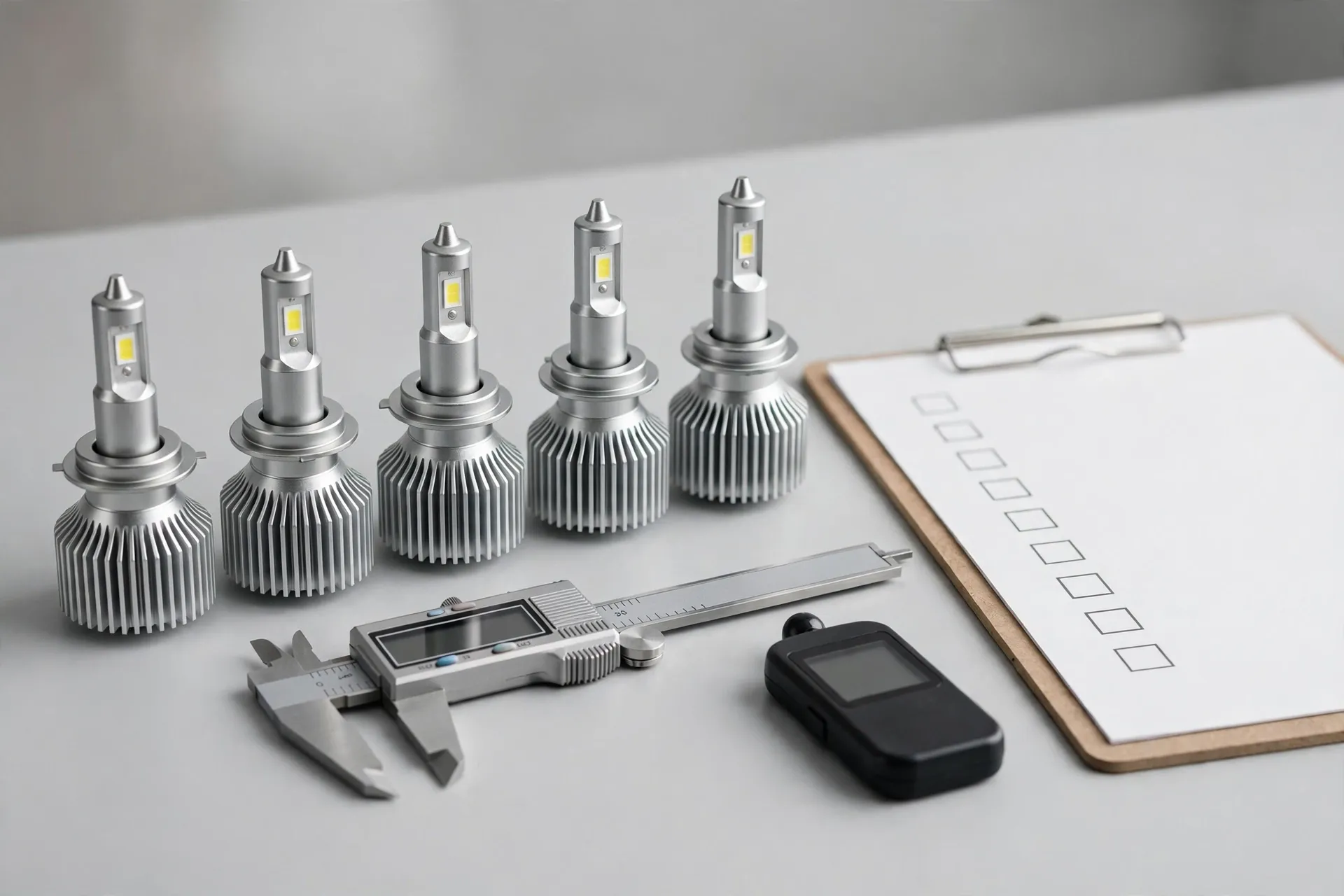
Do it this way instead. Order three to five samples of the same model, and ask the supplier to send them from different production batches. When they arrive, test every one of them — not just the prettiest. Fit each bulb in a real headlight housing, not on a bench: does it close under the dust cover? Does it flicker on daytime running light (DRL) mode? Does it throw a bulb-out warning on the dashboard? Check the beam pattern on a wall and compare the cutoff line across all five samples. If the cutoff moves from unit to unit, the factory's process control is loose, and your bulk order will inherit that looseness.
Weigh the samples and compare them with the spec sheet weight. A lighter unit usually means a thinner heat sink or a smaller driver — the two places where cost-cutting hides first. Open the driver compartment if you can: smooth, shiny solder joints and heat-shrink tubing over connections are good signs; dull, grainy solder and electrical tape are not.
Then seal one golden sample and keep it. Label the golden sample with the model, the date and the batch, and write into your purchase order that bulk goods must match the sealed golden sample within agreed tolerances — for color temperature, for power draw, for light output. A contract that defines tolerance ranges is what lets you reject a bad shipment. Take a typical scenario: a distributor pays for 1,800 lights, and the batch arrives well below the spec sheet on output, with color temperature drifting from unit to unit — but the contract never defined a tolerance, so there are no grounds to refuse the shipment. The failure was predictable. The prevention costs a few samples and one paragraph in the contract. Ask the supplier to propose the tolerance figures for color temperature, power draw and light output, and have the agreed figures written into the purchase order.
5. Walk the Factory Floor — Even on Video
A factory audit does not have to mean a plane ticket. A live video walk, with you directing the camera, covers most of what matters. When is a visit worth the cost? If the first order is large enough that one bad batch would hurt for months, or if you plan to reorder the same models for a year or more, seeing the floor in person — or at least a thorough live video audit — pays for itself before the first shipment. Ask to see five things: incoming material control (are LED chips and drivers checked on arrival, or just counted?), the assembly and soldering stations, the aging-test area (are finished bulbs burned in — run for a period to catch early failures — before packing, and for how long?), the calibration records for the test equipment, and the defect records — what failed last month, and what corrective action followed. A factory that keeps defect records and can show you the corrective action is a factory that improves. A factory that claims it has no defects is a factory that does not look.
Also ask about traceability. Can the supplier trace a finished bulb back to its LED chip batch, its driver batch and its production date? If a problem surfaces in your market six months later, that traceability is the difference between recalling one batch and recalling everything. And ask who does the subcontracted work, if any. Outsourced processes are not a problem by themselves — undisclosed ones are.
6. Get the Warranty in Writing, With Teeth
A warranty that lives only in a chat message is not a warranty. Before you pay a deposit, get it in writing and check four points: how long it lasts, what it covers, who pays the return freight, and how fast the supplier responds to a claim. A warranty of 18 months is the standard a serious LED headlight supplier should be willing to stand behind — it is long enough to cover real-world use, and it is a commitment a factory makes only when it trusts its own thermal design and driver quality. If a supplier offers three months, or hedges with "depends on the situation," that is the factory telling you its own failure rate.
For reference, SUNRISE backs its LED headlight bulbs with an 18-month warranty, in writing before you pay the deposit — not as a favor, but as part of the standard terms. The same applies to the rest of the terms below: they are written down before the deposit moves, so neither side has to rely on memory when something goes wrong. Whatever supplier you choose, insist on the same. If the warranty cannot be written down, it cannot be claimed.
7. Confirm MOQ, Payment and Lead Time in the Same Conversation
Take a typical scenario: you move a few hundred sets a month and want to test a new socket without tying up cash in a thousand sets. The supplier's MOQ decides whether that test is even possible. A genuine factory has real minimums for stocked items, because production runs have a setup cost. An extremely low MOQ with no conditions is often a trading company marking up someone else's stock. An MOQ in the thousands for a first trial order is a supplier that does not want small distributors at all. Neither is automatically wrong. What matters is that the MOQ fits your business, and that the supplier is honest about why it is set where it is.
Ask the same direct questions about payment and lead time, and get the answers in the same written terms as the warranty. Standard practice in this industry is telegraphic transfer (T/T), with 30 percent deposit and 70 percent before shipment. Lead time should be split into two cases: in-stock items ship within one week, and made-to-order items take 20 to 30 days after deposit — with custom packaging agreed in writing in advance. On packaging, the tiers should be explicit: neutral color boxes from 50 sets, your logo printed free from 100 sets, and fully custom color boxes from 1,000 sets. If any of these numbers change between the quotation, the chat and the proforma invoice, that drift is itself a finding. A supplier whose terms move is a supplier whose promises move.
8. Test Fitment Data Before You Trust the Catalog
Fitment problems — not defects — are one of the most common causes of returns in aftermarket lighting. A bulb that bolts on 95 percent correctly is a 100 percent return, and it is your customer standing in your shop while it happens. So probe the supplier's fitment data hard. Do they maintain year-by-year application data, or one-size-fits-all listings? Can they tell you which mid-year production changes affect interchangeability? When you ask about a specific model, do they answer with specifics — connector variants, trim-level differences, regional spec changes — or with a generic "it fits most cars"?
The good suppliers answer with uncomfortable specificity, because their tooling came from actual measurements of the original lamp, not from copying another aftermarket part. And remember the physical check: compact bulbs designed to fit under the dust cover exist precisely because oversized bulbs cannot close under it, and a bulb that does not fit the housing is a return no matter how good its beam pattern is. Ask the supplier which of their models are compact enough for the socket you sell most, and verify it with the golden sample in a real housing.
9. Read the Driver and the Decoding Story
Two bulbs can share a socket and behave completely differently once installed, and the difference is almost always the driver. Ask whether the decoding is built in or external — and beware any supplier who cannot answer clearly. As a rule of thumb, the HT series uses an external, standalone decoder driver, while the HTD series carries the driver built in. A supplier who mixes them up in conversation will mix them up in your shipment too.
Ask specifically about the failure modes your customers will actually meet: flicker on PWM-driven daytime running lights, bulb-out warnings on European cars with lamp monitoring, and error messages that only appear on certain model years. A supplier who has sold into your market before will name the problem vehicles without prompting. One who promises the bulb is "error free for all vehicles" has just told you they have not tested it — no honest supplier makes that promise, because decoding depends on the vehicle. The right answer sounds like "most vehicles, with decoder support where the car needs it," backed by a list of models already tested.
10. Put It All on One Page Before You Pay
Here is the checklist, distilled. Run every new supplier through it before the deposit, and keep the completed sheet on file — it is your evidence if anything goes wrong later.
- Business license verified; quotation, contract, invoice and bank payee all name the same entity.
- Factory address given; live video walk of assembly, aging test and warehouse completed.
- Certificates checked by number and issuing body; test reports provided, not just logos.
- Beam pattern and photometric test data supplied with test conditions.
- Three to five golden samples received from different batches and tested in a real housing — dust cover, DRL flicker, dashboard warning, cutoff consistency.
- One golden sample sealed and labeled; tolerance ranges written into the purchase order.
- Incoming material control, aging test, calibration records and defect corrective actions confirmed.
- Warranty in writing: length, coverage, return freight, claim response time.
- MOQ, payment terms and lead time confirmed in writing and identical across quotation and proforma invoice.
- Fitment data checked model by model; driver and decoding type confirmed for your best-selling sockets.
Two red flags disqualify a supplier on their own: refusal to show test data behind a claimed certification, and a bank payee that does not match the contracting company. Everything else can be negotiated — those two cannot.
What a Good Answer Looks Like
Vetting a supplier is not about catching someone out. It is about finding the factory that answers direct questions with documents, numbers and a sample you can test — and then writing down what was agreed so both sides are protected. The best suppliers welcome the checklist. It costs them nothing to pass, and it costs you a season to skip.
If you are vetting suppliers for your next order, start with the checklist above and run it on whoever you are talking to — including us. Send us your model list or your target vehicle range, and we will answer the same ten points for SUNRISE: the spec sheet for the models you list, golden samples from production batches, the written 18-month warranty, and the exact terms — in-stock neutral color boxes from 50 sets, your logo printed free from 100 sets, custom color boxes from 1,000 sets, T/T 30 percent deposit and 70 percent before shipment, in-stock items shipping within one week. If a point does not fit your market, we will say so before you pay anything — because a supplier you can verify is a supplier you can reorder from.
Send your model list to WhatsApp +86 173 6284 6689 or sherry@chuxuparts.com, and we will come back with a quotation and samples for the models you actually sell.
FAQ
Q1: What is the minimum order quantity for a first trial order?
For in-stock items in neutral color boxes, the MOQ is 50 sets — enough to test a model in your market without over-committing. Logo printing is free from 100 sets, and fully custom color boxes start at 1,000 sets. Confirm the MOQ per model on the quotation.
Q2: How do golden samples work, and do I have to pay for them?
Ask for three to five samples of the same model from different production batches, test each one in a real housing, and seal one as your reference. Confirm sample pricing and any credit arrangement on the quotation before you order, and get the tolerance ranges written into the purchase order.
Q3: Can I put my own brand on the bulbs and the box?
Yes. Logo printing on the product and the box is free from 100 sets; fully custom color boxes start at 1,000 sets with a $0.50 per set surcharge. Send your artwork with your model list and we will confirm print placement and proof timing before production.
Q4: How long does delivery take?
In-stock items ship within one week of order confirmation. Items without stock take 20 to 30 days after deposit. Custom packaging is agreed in writing in advance — the exact date is confirmed on the proforma invoice, not estimated in chat.
Q5: How do I know the bulbs will not trigger dashboard errors on my customers' cars?
That depends on the vehicle, which is why decoding type matters: HT series bulbs use an external standalone decoder driver, while HTD series bulbs carry the driver built in. Tell us the makes and model years you sell to, and we will confirm which design fits and whether a decoder is needed. No honest supplier promises a bulb is error-free for every vehicle — the right check is model-by-model confirmation before you order.
Q6: What does the 18-month warranty actually cover?
The warranty runs for 18 months. The exact coverage, start date and remedy are set out in the written warranty wording — ask for it on the quotation and order confirmation before you pay the deposit.