
Installation & Troubleshooting
Dashboard Bulb-Out Warning After LED Install? CANbus Decoders Explained for Distributors
Dashboard Bulb-Out Warning After LED Install? CANbus Decoders Explained for Distributors
You shipped 500 sets of LED headlight bulbs to a good customer. Two weeks later the phone calls start. "The dashboard says the bulb is out — but the light is on." "The headlights flicker every time I start the car." "My customer wants his money back."
The bulbs are not broken. The car is not broken. What is broken is the conversation between the two — and if you sell LED headlights for a living, this is the single most expensive misunderstanding in the business. A bulb-out warning does not just cost you one return. It costs you the retailer's confidence, the installer's afternoon, and the end customer's trust in LED upgrades altogether. The fix is a small component called a CANbus decoder, and understanding it properly is the difference between a distributor who keeps getting repeat orders and one who keeps paying return freight.
This guide explains what a CANbus decoder actually does, when your customers need one, when they do not, and how to buy and stock LED bulbs so the warning light never becomes your problem.
What CANbus Does Inside a Modern Car
CANbus — Controller Area Network — is the nervous system that lets a car's computer talk to its parts. Since the mid-2000s, most cars built for the European and North American markets use it to watch the headlights. The system sends a small pulse of current through each bulb circuit and measures what comes back. A halogen bulb draws around 55 watts on low beam. If the computer sees far less power than that, it concludes the bulb has failed, even when the bulb is shining perfectly well.
That is exactly what happens with an LED upgrade. A quality LED headlight bulb draws far less power than the halogen bulb it replaces — that is one of the reasons people buy LEDs in the first place. But to a car that was designed around halogen resistance values, a bulb drawing a fraction of the expected current looks like a dead bulb. The dashboard warning is the car's honest response to a measurement it was never taught to interpret any other way.
The problem is most common on European cars — Volkswagen, Audi, BMW, Mercedes-Benz — and on many newer American trucks and SUVs. It also shows up on vehicles with daytime running lights (DRL) and on cars that dim the headlights with pulse-width modulation, or PWM. A PWM system flicks the power on and off many times per second to control brightness. Halogen filaments are too slow to notice. LEDs respond instantly, so the flicker becomes visible.
The Four Symptoms Your Customers Will Report
When a distributor's phone rings about this, the complaint is almost always one of four things. Learn to recognize them, because each one points at the same root cause and each one has the same answer.
1. The bulb-out warning. The dashboard shows a bulb failure icon or a "check headlight" message, even though the LED is lit. This is the classic CANbus detection problem: the car sees low current and assumes a dead bulb.
2. Flickering or strobing. The LED flashes rapidly, especially at startup or in DRL mode. This is usually PWM dimming meeting an LED that reacts faster than a halogen filament ever could. Our flickering guide covers the full list of causes, and CANbus mismatch sits at the top of it.
3. The bulb lights up, then shuts off. The car runs its bulb check, decides something is wrong, and cuts power to the circuit. The customer restarts the car, the bulb works for a few seconds, and the cycle repeats. This one generates the angriest phone calls, because the product looks defective when it is not.
4. One side works, the other does not. The car monitors each side separately. A small difference in the circuit — a slightly different ground, a different length of factory wiring — can push one side over the detection threshold and leave the other side fine. Customers assume they received one good bulb and one bad one. In almost every case, both bulbs are fine.
If you hear any of these four, do not start by replacing the bulb. Start by asking what car it is in.
What a CANbus Decoder Actually Is
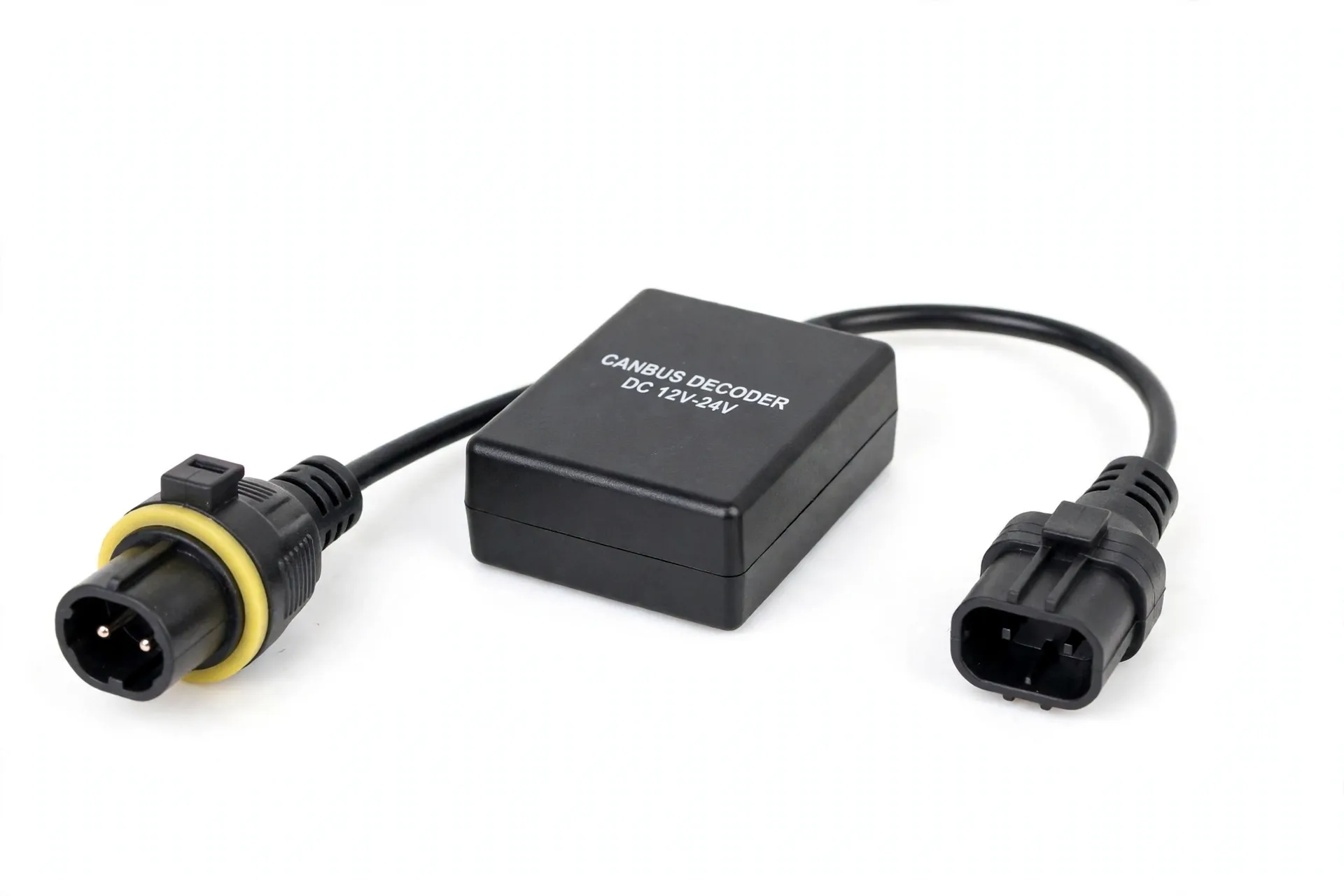
A CANbus decoder — also sold as an anti-flicker module, a warning canceller, or an error-free adapter — is a small plug-and-play module that sits between the car's wiring and the LED bulb. Inside it is a resistor and capacitor circuit that does one simple job: it draws enough additional current to make the car's computer see a load close to what a halogen bulb would present. The car runs its check, the numbers look normal, the warning stays off, and the LED works as intended.
There are two ways to deliver that function, and the difference matters for your buying decisions.
Built-in decoding. The decoder circuit is designed into the bulb's driver itself. The bulb arrives as a single unit — no extra box, no extra wiring, nothing to hide behind the headlight housing. SUNRISE's HTD series works this way: the driver is built into the bulb, which is why the HTD line covers the full D-series range — D1S, D1R, D2S, D2R, D3S, D3R, D4S, D4R, D5S and D8S — as a direct replacement for factory HID bulbs. For a distributor, built-in decoding is the easiest product to sell: fewer parts, fewer installation mistakes, fewer "where does this box go" calls from the installer.
External decoding. The decoder is a separate module on its own harness. SUNRISE's HT series uses this approach: a separate external driver that also carries the CANbus decoding function. The advantage is flexibility — the decoder can be sized and tuned for the vehicle, and if a car is unusually sensitive, the module can be swapped without replacing the bulb. The trade-off is installation: the module needs a place to sit, and it gets warm in use, so it must not be stuffed inside a sealed dust cover with no airflow.
Neither approach is "better" in the abstract. The right question is which one fits the vehicle and the installer. A compact housing with no spare room favors built-in decoding. A sensitive European model that has already rejected one LED kit favors a separate external decoder that can be matched to the car.
| Built-in decoder (HTD series) | External decoder (HT series) |
|---|---|---|
Parts in the box | Bulb with driver inside | Bulb + separate decoder module |
Installation | Plug and play, nothing extra to mount | Module needs a mounting spot with airflow |
Best for | D-series HID replacements, tight housings | Sensitive European models, high-power builds |
Installer errors | Very few | Wrong placement, pinched wires |
Distributor stocking | One SKU per socket | Bulb SKU + matching decoder SKU |
When Your Customers Need a Decoder — and When They Don't
Not every car needs one, and telling a customer they do when they don't is how you lose a sale to a cheaper competitor. Use this as a working guide, and confirm with a sample test before committing to a large order.
Almost always needs a decoder: European cars from roughly 2008 onward — Volkswagen, Audi, BMW, Mercedes-Benz, and many Peugeot, Renault and Volvo models. These cars monitor bulb current aggressively. Also: vehicles with PWM-controlled DRL, and most trucks running 24-volt systems, where the voltage difference alone can confuse a bulb designed for 12 volts.
Often needs a decoder: Newer American and Japanese cars with bulb-out monitoring — many recent Ford, Chevrolet, Jeep, Toyota and Honda models. The only reliable answer here is a sample test on the exact model year, because the same model can change its monitoring behavior between facelifts.
Usually does not need a decoder: Older cars with simple relay-switched headlights and no bulb monitoring, and many motorcycles and commercial vehicles with basic wiring. For these customers, a decoder is unnecessary cost and complexity. Sell them the simpler bulb and say so — honesty here is what brings them back for their next order.
The practical rule for a distributor: keep a small set of sample bulbs and decoders on your own shelf, and test-fit on the three or four most common models your customers ask about before you place a volume order. One afternoon of testing saves a month of returns.
Five Buying Mistakes That Create Returns
1. Buying the cheapest decoder on the market. A decoder is a resistor that turns electricity into heat. A cheap one uses a small resistor with no heat management, and it fails — sometimes within weeks — taking the "error-free" promise with it. Ask your supplier how the decoder handles heat, and what the warranty covers. SUNRISE backs its bulbs with an 18-month warranty; a decoder that dies in month two is not a bargain at any price.
2. Ignoring the DRL mode. Many bulbs pass a static bench test and then flicker the moment the car drops into daytime running light mode, because DRL runs the bulb at reduced voltage through PWM. Always test in DRL mode, not just in full low-beam mode. If your supplier cannot tell you how their bulb behaves under PWM, that is an answer in itself.
3. Stuffing the decoder inside the dust cover. External decoders get warm. Sealing one inside a dust cover with no airflow is the fastest way to shorten its life. Installers need a clear instruction: mount the module on metal, away from moving parts, with air around it. If the housing has no room, that is a signal to choose a built-in decoder bulb instead. Our fan vs fanless comparison covers the same heat logic for the bulb itself — heat is the enemy of every component in the housing, not just the LED chips.
4. Promising it fits every car. No decoder fits every car. Some vehicles — a handful of late-model European cars with the most sensitive monitoring — will reject even a good decoder and need a vehicle-specific solution. A supplier who promises their decoder works on every car ever made is selling you a slogan, not a product. The honest claim is "works with most vehicles we test, and we will tell you which ones need something different." That is the claim worth printing on your own listings.
5. Ordering one socket and hoping it covers the range. H11, H7, 9005, 9006 and H4 do not share decoders. Each socket needs its matching module and connector. When you place an order, match the decoder SKU to the bulb SKU, socket by socket, and confirm it in writing with your supplier before the goods ship.
A Distributor's Pre-Shipment Checklist
Before a bulk order leaves the factory, run through this list. It takes one email exchange, and it prevents the problems above.
- Sample test on real cars. Ask for samples and fit them on the exact models your customers drive most — not just on a bench. Include a DRL-mode test and a cold start.
- Confirm decoder type in writing. Built-in or external? For the HT series, the decoding lives in the separate external driver; for the HTD series, it is built into the bulb. Get the answer per model, not as a general statement.
- Check the connector. The decoder must match the socket — H11, H7, 9005, 9006, H4, or the D-series base. A wrong connector is discovered at the installer's bench, at your expense.
- Ask about heat and placement. Where does the supplier recommend mounting an external decoder? What clearance does it need? Put that instruction on your own packing insert.
- Confirm warranty and returns handling. An 18-month warranty is only useful if the replacement process is clear. Ask how defective units are handled before you need to know.
Frequently Asked Questions
Do all LED headlight bulbs need a CANbus decoder?
No. Cars without bulb monitoring work fine with a plain LED bulb. European cars from around 2008 onward, many newer American and Japanese models, and most vehicles with PWM daytime running lights are the ones that need it. When in doubt, test a sample on the exact model.
Will a decoder fix flickering?
In most cases, yes — if the flicker is caused by CANbus detection or PWM dimming. If the flicker comes from a loose connector, a failing alternator, or a damaged socket, no decoder will help. That is why the first step is always diagnosis, not parts swapping.
Can one decoder fit all sockets?
No. Decoders are socket-specific. An H11 decoder does not fit an H7 bulb. Order the decoder matched to each socket, and confirm the pairing with your supplier.
Is an external decoder better than a built-in one?
It depends on the car. Built-in decoding, as in the HTD series, is simpler to install and ideal for tight housings and D-series replacements. External decoding, as in the HT series, gives you more flexibility on sensitive vehicles and can be swapped independently of the bulb. Stock both, and match the product to the vehicle.
Does installing LED bulbs with a decoder void the vehicle warranty?
That depends on local law and the vehicle manufacturer's policy, and it varies by market. What we can say is that a plug-and-play decoder requires no cutting or splicing of factory wiring, which is the modification most likely to cause a warranty dispute.
What is the minimum order, and can I test samples first?
Yes — samples are the right way to start, and we recommend testing on your most common local models before a volume order. In-stock items in neutral color boxes start at 50 sets; private label and custom packaging start at 1,000 sets. In-stock orders ship within a week; orders without stock ship 20–30 days after deposit; custom specifications are agreed in writing before production.
The Bottom Line for Your Next Order
Dashboard errors are not a product defect — they are a mismatch between a modern car's monitoring system and a bulb that draws less power than the halogen it replaces. Once you understand that, the whole problem becomes manageable: choose built-in decoding for tight housings and D-series replacements, choose an external decoder for sensitive vehicles, test samples on the real cars your customers drive, and never promise a fit you have not verified.
Distributors who handle this well do not just cut their return rate. They become the supplier their retailers call first, because the installer's afternoon went smoothly and the end customer never saw a warning light. That is the kind of reputation that turns a one-time trial order into a standing relationship.
If you are stocking LED headlights for the coming season, send us your model list or your target vehicle range. We will tell you honestly which of our bulbs need an external decoder, which ones carry decoding built in — like the fanless K9, which runs on 9–30V and suits both 12V cars and 24V trucks — and which models are worth a sample test first. Contact us on WhatsApp at +86 173 6284 6689 or by email at sherry@chuxuparts.com for a quotation and samples.