
Product Knowledge
H4 Mini Projector Lens Bulbs: Why Southeast Asia's Best-Selling Upgrade Is Now a Distributor's Easiest Win
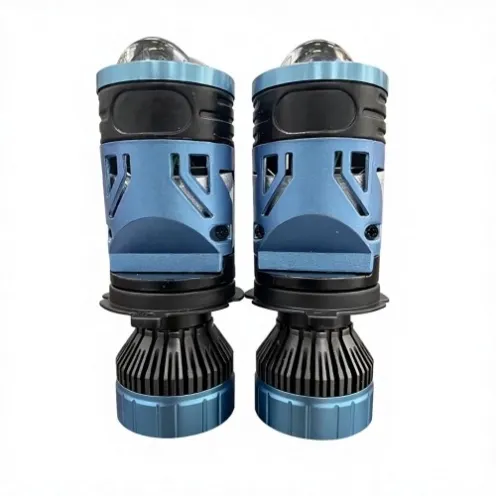
H4 Mini Projector Lens Bulbs: Why Southeast Asia's Best-Selling Upgrade Is Now a Distributor's Easiest Win
If you sell LED headlight bulbs in Southeast Asia, you already know the pattern. A customer buys a standard H4 LED bulb, fits it into a halogen reflector housing, drives one night, and comes back angry. The beam is scattered. Oncoming drivers flash their lights. The cutoff line — the sharp horizontal edge that keeps low beam out of other drivers' eyes — is gone. You take the return, you lose the margin, and you lose a little trust every time it happens.
That single complaint is quietly reshaping what sells. Across Shopee and Tokopedia, the H4 bulbs moving in the largest volumes right now are not plain LED bulbs. They are H4 mini projector lens bulbs: a bulb with a small projector lens built into the tip, designed to drop straight into a standard H4 halogen housing and produce a projector-style cutoff without rebuilding the headlight. Marketplace bestseller lists show the leading models moving in the tens of millions of units in Indonesia and the Philippines, with strong monthly sales on TikTok Shop as well. For a distributor or retail buyer, this is no longer a niche retrofit product. It is the default H4 upgrade your customers are already searching for — and the question is whether you stock a version that actually works, or keep absorbing returns on bulbs that don't.
What an H4 mini projector bulb actually is
A conventional H4 LED bulb puts LED chips where the halogen filament used to sit and hopes the reflector does the rest. In many older reflector housings, it doesn't. The light goes everywhere, and the low beam has no defined edge.
An H4 mini projector bulb changes the optics, not just the light source. A compact lens assembly sits at the front of the bulb, inside the same H4 base and roughly the same overall envelope as the bulb it replaces. The lens collects the LED output and projects it forward with a defined cutoff line — the same principle as a full projector retrofit, shrunk into a plug-and-play bulb. High and low beam switch the same way as a standard H4 bulb, through the existing wiring and connector.
Three things make this format different from a full Bi-LED lens retrofit, and each one matters commercially:
- No headlight surgery. A 3.0-inch Bi-LED lens retrofit means opening the headlight, mounting the lens, sealing it again, and often baking the housing. A mini projector bulb installs the way any H4 bulb installs. Your retail customers can fit it in a parking lot; your workshop customers can sell the job in minutes, not hours.
- It fits the cars that dominate the region. The H4 socket is the standard fitment across the volume models of Southeast Asia — Toyota Avanza, Innova and Vios, Honda Brio and Mobilio, Mitsubishi Xpander, Suzuki Ertiga, Daihatsu Gran Max, and millions of older sedans and pickups across the Philippines, Indonesia, Malaysia, Thailand and Vietnam. It is also the standard motorcycle headlight socket in much of the region, which doubles the addressable market for the same SKU.
- It answers the complaint buyers actually make. The top reasons buyers praise mini projector bulbs in marketplace reviews are consistent: a clear cutoff line, less glare for oncoming traffic, and easy installation. Those are the exact three complaints that drive returns on standard LED bulbs.
Why demand is moving this way now
Several forces are converging, and none of them is a fad.
Drivers are more educated about beam quality. A few years ago, "brighter" was the whole sales pitch. Today, buyers in the region's big marketplaces compare cutoff photos before they buy. Listings that show a clean horizontal cutoff with a step for the kerb side outsell listings that only show a bright wall of light. As one market research summary put it, consumers are moving away from simple LED bulbs that scatter light toward integrated lenses that provide a professional beam cut-off — and sellers who can demonstrate that difference command better margins than sellers competing on brightness claims alone.
Regulators are tightening glare enforcement. The glare problem with scattered LED retrofits has drawn regulatory attention in multiple markets, and the direction of travel is toward stricter beam-pattern requirements. Products that produce a controlled cutoff are on the right side of that trend; products that spray light are not. Distributors who build their H4 range around proper optics now are buying insurance against the next round of enforcement, not just this season's sales.
The price is right for the region's buyers. Mini projector bulbs retail roughly in the $$25 range on the big platforms — meaningfully more than a basic LED bulb, but a fraction of a full projector retrofit kit. That is the price band where a distributor makes a real margin while the end customer still feels the upgrade is affordable. It is also the band where a 50-set trial order is a small, sensible test rather than a gamble.
Right-hand-drive markets are a real, specific opportunity. The Philippines, Indonesia, Malaysia and Thailand are all right-hand-drive markets, and the cutoff step of a projector beam is handed: it rises on one side and stays low on the other. A bulb with the wrong handedness throws light into oncoming traffic instead of onto the kerb. Listings explicitly marked for RHD markets are among the best-reviewed in the region. If you serve these markets, handedness is not a detail — it is a buying criterion, and you should confirm it with your supplier before you order, not after your first customer complains.
What goes wrong with cheap mini projector bulbs
High volume attracts low-quality supply, and mini projector bulbs are no exception. If you are selecting stock, these are the failure modes your customers will bring back to you:
A lens that is decorative, not optical. The cheapest units put a plastic-looking lens in front of a standard bulb and call it a projector. The beam is no better than a plain bulb. Ask for a beam-pattern photo — a real wall shot showing the cutoff — before you commit to a model. A supplier who cannot provide one is telling you something.
Heat in a small package. A mini projector bulb packs the LED, the driver and the lens into a very tight space. Poor thermal design shows up as dimming after twenty minutes of driving, or early failure. Fanless designs have an advantage here in dusty, wet conditions — no fan to clog or fail — but only if the heatsink is genuinely sized for the job. Ask how the bulb sheds heat and what happens to output as it warms up.
Inflated wattage and lumen claims. Marketplace listings for this category routinely carry lumen and wattage figures that no physical bulb of this size could sustain. Treat any extreme number as a red flag, not a selling point. Buy on verified specifications, on the beam photo, and on a sample you test yourself — never on the biggest number on the listing page.
Compatibility surprises. The lens assembly makes the bulb slightly longer than a plain H4 bulb in some designs. In tight housings, or behind dust covers, that extra length matters. The other classic problem is electrical: some vehicles monitor the headlight circuit and flag a bulb-out warning when the LED draws less current than the halogen it replaced. That is a CANbus/decoding issue, and it is solvable — but only if you know which of your customers' vehicles need a decoder and you stock the matching solution alongside the bulbs. A bulb that works electrically in nine cars out of ten still generates complaints from the tenth, and the tenth customer is the one who writes the review.
No support when a batch fails. The hidden cost of the cheapest supplier is what happens after the sale. A 50-set order with no warranty behind it is a liability, not a saving. An 18-month warranty from a supplier who answers the phone is worth more than a lower unit price from a supplier who disappears.
A practical stocking checklist for distributors
If you are adding H4 mini projector bulbs to your range this quarter, use this as your buying checklist:
- Beam photo first. Demand a wall-shot photo of the low-beam cutoff from the exact model you are buying. No photo, no order.
- Confirm handedness. RHD or LHD pattern, matched to your market. Get it in writing on the order.
- Test fitment on your top three vehicles. Take the models that sell most in your market — Avanza, Vios, Xpander, or your local equivalent — and confirm the bulb seats fully, the dust cover closes, and the connector locks. A sample order exists for exactly this.
- Check the electrical side. Confirm whether the bulb needs an external CANbus decoder on the vehicles your customers drive, and whether the supplier offers a matched decoder. Our own guidance on this is in our CANbus decoder article.
- Buy a sample batch before the volume order. A small trial — 50 sets is enough to test fitment, beam and heat — costs little and tells you everything a spec sheet cannot.
- Plan the range, not the single SKU. The same customer who buys an H4 mini projector bulb for a Toyota today will ask about a 9005 or H11 version tomorrow, and about a 3.0-inch Bi-LED lens for a full retrofit job. A supplier who covers the whole ladder — mini projector bulbs, standard LED bulbs and full projector lenses — lets you grow the account instead of re-sourcing every time.
What SUNRISE offers for this category
SUNRISE builds H4 mini projector solutions for exactly this buyer: distributors and retail chains who need a bulb that installs like a standard H4, produces a real cutoff, and survives in daily use. Our H4 range includes the HTP5 H4 bi-LED projector lens and the H4 Mini Projector Bulb — both built as plug-and-play H4 replacements for halogen housings, aimed at the cars and motorcycles that dominate Southeast Asian roads. For customers who need a full retrofit rather than a bulb swap, our 3.0-inch Bi-LED projector lenses cover the professional-installation end of the same market — see our comparison of 1.5-inch mini versus 3.0-inch lenses .
The commercial terms are the same across the SUNRISE range, and they are designed for a trial-first relationship:
- 18-month warranty on the products you stock.
- 50 sets minimum for in-stock items in neutral colour boxes — enough to test a market without overcommitting.
- Logo printing free from 100 sets, so your own brand goes on the box once the product proves itself.
- Custom colour boxes from 1,000 sets (plus $0.50 per set) for a full private-label presentation.
- In-stock items ship within one week; items without stock ship 20–30 days after deposit; custom work is agreed in writing in advance.
- Payment by T/T, 30% deposit and 70% before shipment.
One caution, because it protects both of us: SUNRISE makes LED retrofit bulbs and projector lenses only. We do not sell HID xenon kits, and a mini projector LED bulb is not a drop-in for a factory HID system — D-series vehicles need our HTD LED replacements, which are built for that job. If you are unsure which of your customers' vehicles take H4 and which take a D-series bulb, send us the list and we will sort it with you before you order.
FAQ
What is the minimum order for H4 mini projector bulbs?
50 sets for in-stock items in neutral colour boxes. Logo printing is free from 100 sets, and custom colour boxes start at 1,000 sets.
Can I get samples before placing a bulk order?
Yes. Samples are the normal first step — we recommend testing fitment and beam pattern on your top-selling vehicle models before committing to volume. Ask for a sample quotation with your model list.
Do these bulbs fit behind the dust cover?
That depends on the vehicle housing. Most H4 housings accept the mini projector format, but some tight housings need checking. Test-fit on your best-selling models first, and tell us the vehicle list — we will confirm fitment before you order.
Will they trigger a dashboard bulb-out warning?
On most vehicles, no. On vehicles with bulb monitoring, an external CANbus decoder may be needed. Our HT series uses an external decoder driver; our HTD series has the driver built in. Tell us the vehicle models and we will advise which setup applies.
Are they suitable for right-hand-drive markets?
Yes — but confirm the beam handedness when you order. RHD and LHD patterns are different, and ordering the correct version for your market is essential.
What is the lead time?
In-stock items ship within one week. Items without stock ship 20–30 days after deposit. Custom or private-label work is agreed in writing before production.
Can I sell them under my own brand?
Yes. Logo printing is free from 100 sets, and full custom colour-box packaging starts at 1,000 sets. We supply distributors and private-label sellers as a core part of the business.
Do you make a full projector lens as well, for retrofit shops?
Yes. Our 3.0-inch Bi-LED projector lenses serve professional retrofit work, and our lens comparison article explains when a bulb swap is enough and when a full lens is the right recommendation.
The bottom line
The H4 market in Southeast Asia has already voted: buyers want a bulb that fits like an H4, aims like a projector, and doesn't come back as a return. The distributors winning this category are not the ones shouting the biggest lumen number. They are the ones who tested the beam pattern, confirmed the handedness, checked the dust cover, and stocked a bulb their workshops can install in minutes and stand behind for 18 months.
If that is how you want to sell H4, start with a sample. Send us your model list — the vehicles your customers drive, and the quantities you have in mind — and we will come back with a quotation, a sample plan, and honest fitment advice before you spend anything on stock.
Contact us for a quotation and samples: WhatsApp +86 173 6284 6689 or sherry@chuxuparts.com. Send your vehicle model list or target models, and we will reply with pricing and a sample plan.