
Sep 10, 2026
How to Read an LED Headlight Datasheet Before You Buy
Learn how to read LED headlight specifications including wattage, lumens, chip, voltage, color temperature, driver, cooling and socket options before buying wholesale.
A supplier sends a specification sheet.
It contains:
300W
30000LM
CSP chip
6500K
IP68
CANBUS
Turbo fan.
It looks impressive.
But what do these numbers actually tell you?
And more importantly:
What do they not tell you?
For wholesale buyers, learning how to read a technical datasheet can prevent poor purchasing decisions.
1. Product Model
Start with the model number.
This sounds obvious, but it is essential.
The model should remain consistent across:
- quotation
- catalog
- sample
- packaging
- purchase order
If several similar products share confusing names, create your own internal SKU.
Model identity comes before specifications.
2. Power
Power is usually shown in watts.
But buyers should clarify what the number represents.
Ask:
Is this per bulb?
Per pair?
Nominal input?
Measured operating power?
Different suppliers may present power differently.
Do not compare two products until you know the measurement basis is the same.
3. Lumens
Lumens describe luminous flux.
But lumen figures can also be presented in different ways.
A buyer should understand whether the supplier is stating:
- per bulb
- per pair
- theoretical LED output
- measured system output
Do not assume all catalog numbers were measured using identical methods.
For headlights, also remember:
usable road illumination depends on beam pattern, not only lumens.
4. LED Chip
The datasheet may show:
CSP
COB
or a specific chip model.
This helps identify the product.
But chip name alone should not determine the purchasing decision.
Evaluate:
- light-source geometry
- chip positioning
- thermal design
- beam performance
The chip is only one component.
5. Voltage
Check the operating range.
For example:
DC 9–30V
provides more information than simply:
12V.
The operating range helps determine whether the product is intended for different vehicle electrical systems.
Do not assume 24V support unless confirmed.
6. Color Temperature
Common values may include:
3000K
4300K
6500K.
Color temperature describes light appearance.
It does not directly mean brightness.
Make sure the quotation, packaging and website all show the same confirmed value.
7. Cooling System
Look for information such as:
- fan cooling
- fanless
- aluminum heat sink
- copper heat pipe
- PCB structure
But do not evaluate these components individually.
A large fan does not automatically mean a better product.
8. Driver Structure
The product may use:
- integrated driver
- separate driver
This affects:
- installation
- packaging
- available space
- product architecture
Driver structure is not the same thing as CANBUS compatibility.
Keep these concepts separate.
9. CANBUS Information
If a datasheet says:
CANBUS,
ask what this actually means for the product.
Does it refer to:
- integrated electronic design?
- separate decoder?
- tested vehicle applications?
Avoid interpreting CANBUS as:
works with every vehicle.
Electronic compatibility remains vehicle-specific.
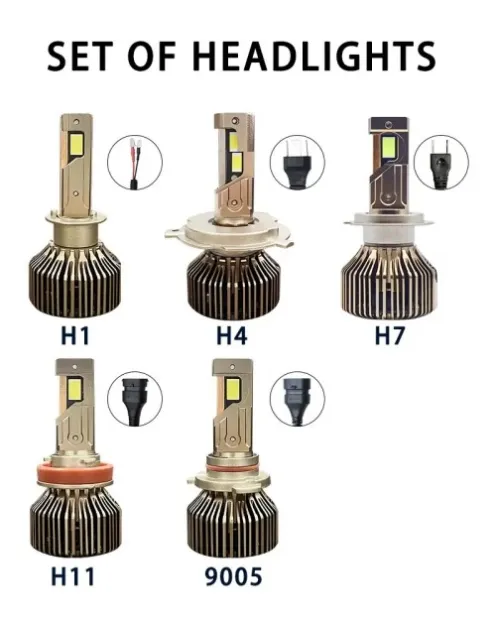
10. Socket Options
Check which sockets are actually available in that exact series.
Common options may include:
- H1
- H4
- H7
- H11
- 9005
- 9006
But not every product series supports every socket.
Do not assume one photo represents the entire range.
11. Dimensions
Dimensions are often missing from wholesale quotations.
They should not be.
Important measurements may include:
- overall length
- rear diameter
- mounting structure
- driver size
This information can help predict installation problems.
For H7 especially, dimensions can be commercially important.
12. IP Rating
If the datasheet lists:
IP68
or another ingress-protection rating,
ask whether it is verified for the exact product.
Do not copy the claim automatically into your own catalog without understanding the supporting documentation.
13. Packaging
Wholesale buyers need more than product specifications.
Ask for:
- pieces per box
- sets per carton
- carton dimensions
- gross weight
- product packaging dimensions
This information affects landed cost.
14. MOQ
MOQ should be understood at the correct level.
Ask:
MOQ per model?
Per socket?
Per order?
Mixed models allowed?
One supplier may offer a low total MOQ but require high quantity per socket.
That changes inventory risk.
15. OEM Options
Private-label buyers should clarify:
- logo
- box
- labels
- manuals
- carton markings
Also ask whether OEM requirements change:
- MOQ
- price
- lead time
Do not assume customization is free.
16. Lead Time
Lead time should distinguish between:
- sample
- standard production
- customized packaging
- repeat order
A heavily customized first order may require more time than a standard product.
Plan accordingly.
17. Warranty Information
If a warranty period is stated, ask:
- What is covered?
- What is excluded?
- How are claims handled?
A number alone does not define the warranty process.
What Is Missing From Most Datasheets?
This is perhaps the most important section.
A specification sheet usually does not fully tell you:
- real vehicle fitment
- beam quality
- CANBUS behavior on every car
- long-term production consistency
- installation difficulty
- customer acceptance
Compare Datasheets Using the Same Template
For each supplier, record:
Model
Power basis
Lumens basis
Chip
Voltage
Color temperature
Cooling
Driver
Sockets
Dimensions
Packaging
MOQ
Sample
OEM
Lead time
Then identify missing information.
This makes supplier comparison much more objective.
Watch for Contradictions
If one document says:
20000LM
and another says:
24000LM,
stop.
Do not choose whichever number looks better.
Ask the supplier which specification is current.
Product-data consistency matters.
A Datasheet Is the Beginning, Not the Final Decision
The purpose of a datasheet is to help you understand the product.
It does not replace:
- samples
- installation tests
- beam evaluation
- supplier assessment
- commercial analysis
Strong sourcing combines documentation and real testing.
Request Current Product Information from Sunrise Auto Parts
Sunrise Auto Parts supplies automotive LED headlight bulb products for international wholesale and private-label buyers.
Tell us your required sockets, product positioning and estimated quantity, and we can provide relevant product information for comparison and sample evaluation.