
Product Knowledge
How to Replace HID with LED: D1S, D2S, D3S, D4S, D5S and D8S Conversion Guide
Replacing a factory HID (xenon) bulb with an LED is no longer an experiment: LED replacements now exist for every common D socket — D1S, D2S, D3S, D4S, D5S and D8S
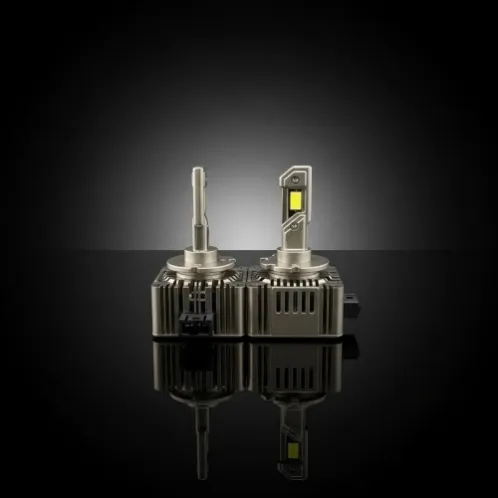
Replacing a factory HID (xenon) bulb with an LED is no longer an experiment: LED replacements now exist for every common D socket — D1S, D2S, D3S, D4S, D5S and D8S — and a purpose-built range such as the SUNRISE HTD D Series covers all of them with one product family. The conversion removes the two biggest HID headaches, aging bulbs and expensive ballasts, but it has rules. Match the exact socket (a D3S is not a D1S, however similar they look), understand what happens to the factory ballast, and align the LED chips after installation. This guide walks through each socket, each step, and the stocking logic for distributors who sell into the HID parc.
Why are owners and distributors switching from HID to LED?
HID bulbs do not usually die suddenly — they fade. Output drops and color shifts toward pink or purple as the bulb ages, so by the time an owner notices, both sides are often due. Then the second bill arrives: when a ballast fails, the replacement part alone can cost more than a pair of LED bulbs. LED replacements answer both problems. They switch on instantly at full output instead of warming up like a xenon arc, they draw less power than the HID system they replace (the HTD runs at 45W per bulb, 90W per pair), and they remove the wear pattern that makes HID light quality a slow decline. For distributors, the logic is the size of the parc: millions of HID-equipped cars from the 2000s and 2010s are now at the age where bulbs and ballasts fail together, and their owners are comparing a like-for-like xenon bill against an LED conversion. That comparison is the sale.
Which D socket does your car actually have?
The socket code is printed on the original bulb's base — always read it rather than guessing from the model year. The six sockets you will meet:
- D1S — The classic premium-car HID bulb, with the igniter integrated into the bulb's base. Common across European models from the HID era.
- D2S — The earlier design, where the igniter lives in the ballast rather than the bulb. Common on older Japanese and European models.
- D3S — The mercury-free successor to D1S, with a similar-looking base. This is the expensive confusion: D1S and D3S run on different operating voltages and their bases are keyed differently. They are not interchangeable — never fit one in place of the other, in either direction, whatever a listing suggests.
- D4S — The mercury-free counterpart of D2S, and the same warning applies: D2S and D4S are not interchangeable.
- D5S — The newer, compact type in which the ballast electronics are integrated into the bulb unit itself, found in more recent models. A D5S replacement must be designed for D5S specifically; search demand for "d5s led headlight bulb" is growing precisely because owners of these cars are now reaching first-bulb-failure age.
- D8S — A lower-power (25W class) variant fitted to some entry-level models. Check the wattage class on the original bulb before ordering. The pattern to remember: the odd numbers (D1S/D3S/D5S) and even numbers (D2S/D4S/D8S) are two families, and within each family the newer socket is a redesign, not an upgrade you can substitute freely.
What happens to the factory ballast when you install LED replacements?
On most D-socket cars, nothing — and that is the point. Purpose-built LED replacements such as the HTD D Series are designed to fit the original socket and work with the car's factory electrical system (12V/24V vehicle systems) with the ballast in place, so the conversion is a bulb swap, not a rewiring job. The LED's own driver electronics regulate what the bulb receives. Two cautions follow. First, only remove or bypass a ballast if the specific replacement product is designed for ballast-bypass installation; mixing approaches — a ballast-fed bulb on a bypassed circuit, or vice versa — is a reliable recipe for no-start and flicker faults. Second, if a converted car flickers or throws a warning, work through the electrical causes methodically (our flickering guide covers all seven) before blaming the bulb. On the HTD range, the driver is built into the bulb, so there is no external decoder box to mount inside a crowded headlight housing and no extra wiring to route — which also means the dust cover closes the way it did with the original bulb.
Why does a built-in driver matter for D-series conversions?
Headlight housings on HID cars were designed around a slim xenon bulb, and space behind the dust cover is tight. An external driver or decoder adds a box that has to be mounted, a cable that has to be routed, and a connection that can work loose — three avoidable problems in the least accessible corner of the car. A built-in driver removes all three, which is why the HTD design integrates it. (For contrast, SUNRISE's HT-series halogen-replacement bulbs use an external, separate CANbus decoder driver — a deliberate architecture for that product family. The D series is the built-in one; do not let a listing blur the two.) Built-in also means the driver and bulb are engineered and tested as one unit, under one warranty — the HTD carries the SUNRISE 18-month warranty.
How do you fix the beam pattern after installing LED replacements?
The most common post-conversion complaint is not brightness — it is a scattered beam pattern that glares at oncoming traffic. The cause is usually "clocking": the rotational position of the LED chips in the housing. The rule is simple: the LED chips should face 3 o'clock and 9 o'clock, side to side, so the reflector or projector shapes the beam the way it did for the xenon arc. The check takes five minutes:
- Park on level ground facing a wall, a few metres back, lights on.
- Look at the cutoff line. A correct install gives a clean, flat cutoff like the original HID pattern.
- If the pattern is scattered, has dark patches, or the cutoff is smeared, switch off, rotate the bulb in its collar to re-clock the chips, and check again. A bulb that cannot be clocked into a clean cutoff in a given housing is a fitment mismatch, not a brightness problem — adding wattage will only add glare.
Which D sockets should a distributor stock first?
Stock where the parc is. D3S and D1S cover the largest share of the European HID fleet now reaching replacement age, and D3S is where conversion search demand concentrates. D2S and D4S serve the older Japanese-model fleet. D5S is the growth line: fewer cars today, but they are the newest HID cars, their first bulb failures are arriving, and supply competition is thinnest. D8S is a niche worth a small quantity for coverage. The operational advantage of a single range like the HTD — one family covering D1S, D1R, D2S, D2R, D3S, D3R, D4S, D4R, D5S and D8S, including the reflector (R) variants — is inventory simplicity: one supplier, one specification standard, one warranty, across the whole D parc. SUNRISE supplies the range on the usual terms: in-stock items from 50 sets in neutral color boxes for trial orders, private label from 1,000 sets, T/T 30% deposit and 70% before shipment, and an 18-month warranty.
FAQ
Can I fit a D3S LED bulb in a D1S housing?
No. D1S and D3S look similar but use different bases and different operating voltages. They are not interchangeable in either direction. Always match the socket code printed on the original bulb.
Do I need to remove the factory ballast for an LED conversion?
For replacements designed to work with the factory system, such as the HTD D Series, no — the ballast stays, the LED fits the original socket, and the bulb's built-in driver regulates the power. Only bypass a ballast with a product specifically designed for it.
Will an LED conversion trigger a dashboard warning?
The HTD's built-in driver is designed to work with the car's factory system, and most conversions complete with no warning. On some particularly sensitive models a warning can still appear; if it does, contact the supplier for the matching solution rather than stacking generic decoders.
What is different about D5S?
D5S integrates the ballast electronics into the bulb unit itself, so it needs a replacement designed specifically for D5S. It is the newest of the common D sockets, and the one with the least aftermarket supply — which is why it is a stocking opportunity as well as a fitment question.
How long will a D-series LED replacement last?
Be skeptical of the 50,000–80,000-hour figures in marketplace listings; independent reviewers put honest LED headlight life at roughly 15,000–30,000 hours. The commitment you can actually enforce is the warranty — 18 months on the SUNRISE HTD range.
Planning a D-series conversion line for your market, or replacing a failed HID bulb and unsure of the socket? Send us the socket code from the original bulb — or a photo of its base — and we will match the HTD model and arrange a sample. Contact us through the site or on WhatsApp: +86 173 6284 6689.