
Aug 27, 2026
2026 Automotive Lighting Aftermarket: 5 Trends Distributors Should Watch
Five automotive lighting aftermarket trends distributors should watch in 2026, from aging vehicle fleets and LED retrofit demand to regulation and integrated headlamp technology.
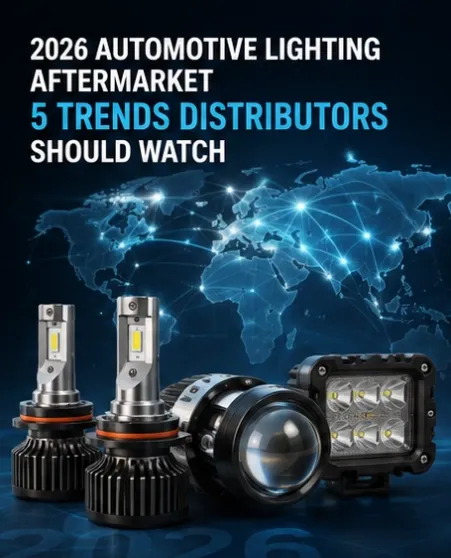
The automotive lighting aftermarket is not standing still.
Vehicle fleets are aging, new vehicles are adopting increasingly integrated lighting systems, LED replacement technology continues to develop, and regulators are paying more attention to optical performance and glare.
For distributors, this creates both opportunity and risk.
The companies that perform best will not simply stock more lights.
They will understand which parts of the market are growing, which technologies are changing, and which products still solve real customer problems.
Here are five trends automotive lighting distributors should watch in 2026.
1. Aging Vehicle Fleets Continue to Support Aftermarket Demand
One of the strongest long-term signals for the automotive aftermarket is vehicle age.
According to S&P Global Mobility, the global light-vehicle population is expected to grow from approximately 1.6 billion vehicles in 2025 to around 1.9 billion by 2034.
Europe is expected to move above an average vehicle age of 14 years in 2026.
In the United States, the average vehicle age reached 12.8 years in 2025.
Why does this matter?
Older vehicles require:
- more replacement parts
- more repairs
- more maintenance
- more aftermarket upgrades
Lighting distributors should pay particular attention to vehicles that are old enough to require repair and replacement but still common enough to create meaningful parts demand.
2. The Replacement Bulb Market Will Become More Segmented
Not every vehicle on the road uses the same lighting architecture.
Older vehicles may still rely heavily on replaceable halogen or HID-style light sources.
Newer vehicles increasingly use:
- integrated LED modules
- complex electronics
- adaptive lighting
- intelligent control systems
This means the aftermarket is becoming more segmented.
Instead of thinking:
LED headlight bulbs are one market,
distributors should increasingly think in several markets:
- halogen-to-LED replacement
- HID/D-Series replacement
- professional retrofit
- projector-lens upgrades
- lighting electronics
- work and auxiliary lighting
The opportunity is becoming broader, but also more specialized.
3. Beam Quality Is Becoming More Important Than Headline Lumens
The aftermarket has spent years competing with larger wattage and lumen numbers.
But regulators and professional buyers increasingly care about what happens after the light leaves the LED chip.
Beam control matters.
Glare matters.
Optical compatibility matters.
UNECE lighting working groups continue to work on LED replacement-light-source categories as well as glare-prevention topics.
That is an important signal for distributors.
Future product competition will increasingly involve:
- beam pattern
- optical positioning
- vehicle compatibility
- controlled light distribution
- regulatory suitability
not only specification-sheet numbers.
4. Integrated Headlamps Are Changing the New-Vehicle Market
Modern OE lighting is becoming much more integrated.
In 2026, major lighting suppliers continue to introduce systems that combine:
- headlamp functions
- electronic control
- styling
- sensors
- digital communication
Some new front-lighting systems integrate lighting with other vehicle technologies rather than treating the lamp as a simple replaceable component.
For aftermarket distributors, this does not mean replacement bulbs disappear tomorrow.
The global vehicle fleet changes slowly.
Millions of vehicles using replaceable light sources will remain on the road for many years.
But it does mean the market will gradually split.
Distributors should keep serving today's replacement demand while watching tomorrow's lighting-electronics and module opportunities.
5. Buyers Are Becoming More Professional About Supplier Selection
As lighting products become more technical, purchasing mistakes become more expensive.
Professional buyers increasingly need:
- consistent specifications
- sample testing
- clear product identification
- repeat-order consistency
- documented OEM requirements
- realistic compatibility information
A supplier that changes wattage, LED chips or product configuration without clear communication creates risk for the distributor.
This means supplier reliability is becoming a competitive advantage.
What Should Distributors Do in 2026?
A practical strategy is to divide your product range into three groups.
Core Replacement Products
High-turnover sockets and applications already proven in your market.
Growth Products
Products such as:
- mini LED bulbs
- CANBUS-oriented products
- Bi-LED projector lenses
- auxiliary lighting
that solve growing aftermarket needs.
Experimental Products
New technologies or feature products that should be tested before large inventory commitments.
This prevents the common mistake of treating every new factory catalog item as a product you need to stock.
Use Local Vehicle Data, Not Only Supplier Recommendations
The biggest industry trend may actually be localization.
There is no universal best-selling LED bulb mix.
A distributor in Tanzania, Peru, Malaysia, Algeria or Germany may face completely different:
- vehicle populations
- customer budgets
- regulations
- socket demand
- installation habits
The strongest distributors will combine supplier information with their own local sales data.
What This Means for Automotive Lighting Suppliers
Suppliers also need to change.
A good supplier should not simply send customers a 100-page catalog and ask:
Which one do you like?
Suppliers should help buyers understand:
- which series serve which market tier
- which sockets belong together
- which models should be sampled
- which claims require application testing
- which products fit the buyer's channel
That creates much more value than another specification sheet.
Plan Your 2026 Product Range with Sunrise Auto Parts
Sunrise Auto Parts supplies LED headlight bulbs, projector lenses, work lights and auxiliary automotive lighting products for wholesale and aftermarket buyers.
Tell us your market, customer type and current product range, and we can discuss which lighting categories may make sense for your next purchasing cycle.
Related Resources
LED Headlight Bulbs: https://www.chuxuparts.com/productsLED Projector Lens: https://www.chuxuparts.com/productsLED Work Lights: https://www.chuxuparts.com/productsHow to Write an RFQ: https://www.chuxuparts.com/posts/how-to-write-automotive-led-lighting-rfq