
Aug 27, 2026
LED Retrofit Regulations in 2026: What Importers Should Check Before Buying
A practical guide for automotive lighting importers on LED retrofit regulation, headlamp approval, market differences and why compliance should be checked before bulk purchasing.
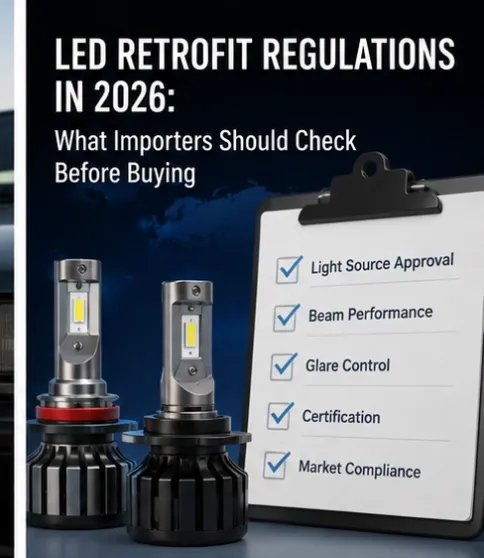
One of the most dangerous assumptions in automotive lighting is:
If the bulb fits, it must be legal.
Mechanical fitment and road legality are not the same thing.
For importers and distributors selling LED retrofit products, regulations need to be considered separately from product performance.
Automotive Lighting Is a Regulated Product Category
Headlamps are safety-related components.
Lighting regulations may control factors such as:
- light-source category
- beam distribution
- lamp approval
- installation
- glare
- signaling functions
Exact requirements vary depending on the country and applicable regulatory framework.
This means a product acceptable in one market may not automatically be road legal in another.
UNECE Rules Continue to Evolve
UNECE's Working Party on Lighting and Light-Signalling continues to develop rules covering automotive light sources and road-illumination devices.
Current work includes additional LED replacement-light-source categories.
UNECE documents have also discussed ongoing development of H4 LEDr and H7 LEDr categories, as well as glare-prevention work.
For distributors, the important message is simple:
LED retrofit regulation is still evolving.
Do not assume that an old understanding of the rules will remain correct forever.
Light Source Approval and Lamp Approval Are Different Questions
A common misunderstanding is thinking that approval of an LED light source automatically makes every headlamp application approved.
Lighting compliance can involve both:
- the light source
- the lamp/headlamp system
The optical system matters.
An LED replacement changes the relationship between:
- light-emitting area
- reflector or projector
- focal position
- beam distribution
That is one reason automotive lighting regulations cannot be reduced to a socket name.
National Rules Still Matter
Even where international UNECE regulations are used, implementation and retrofit permissions can vary by market.
Before importing a large quantity, ask:
- Is this product legal for on-road use?
- Is approval required?
- Is approval vehicle-specific?
- Is the product only suitable for off-road use?
- Are there documentation or marking requirements?
Do not let a supplier answer these questions with:
Everyone sells it.
That is not regulatory evidence.
Be Careful With Certification Claims
Another common sourcing risk is certification language.
A product page may display:
CE
RoHS
E-Mark
or another approval term.
These do not all mean the same thing.
An importer should ask:
- Which exact product is covered?
- Which regulation or standard applies?
- Is there a certificate number?
- Is the certificate current?
- Does it cover road-use approval or only another compliance category?
Never assume one logo proves everything.
Beam Pattern and Glare Are Becoming More Important
Regulators continue to pay attention to headlamp glare.
That means the industry cannot rely forever on a simple sales message:
More lumens = better headlight.
A replacement light source should work properly with the optical system.
For distributors, this strengthens the case for testing:
- cut-off
- beam pattern
- glare
- low/high-beam behavior
before bulk purchasing.
Different Product Categories Carry Different Regulatory Questions
An LED headlight replacement bulb and an off-road work light are not the same regulatory product.
Similarly:
- projector lenses
- auxiliary driving lights
- fog lights
- work lights
- light bars
may fall under different rules depending on use.
Always define whether the product is intended for:
- public-road use
- off-road use
- work-site use
- equipment use
before making claims to customers.
Importers Should Create a Compliance File
For important products, maintain a simple compliance file.
It may include:
- supplier declarations
- applicable certificates
- test reports
- product model
- approved specification
- intended market
- packaging claims
This makes future customer questions much easier to answer.
Do Not Copy Competitor Claims
If a competitor advertises:
Road legal in Europe,
that is not evidence that your product has the same status.
Approval may depend on:
- product
- vehicle
- lamp
- market
- specific regulation
Build your own documentation.
Compliance Can Become a Competitive Advantage
Many distributors think regulation is only a burden.
It can also create trust.
A buyer who clearly explains:
where a product is intended to be used
what has been verified
and what still requires application checking
will often look more professional than a seller making universal promises.
Ask Sunrise Auto Parts About Product Documentation
Sunrise Auto Parts supplies automotive LED lighting products for wholesale and aftermarket buyers.
Tell us your target market and intended application so we can discuss available product information and sample options.
Related Resources
LED Headlight Bulbs: https://www.chuxuparts.com/productsCANBUS LED Headlight Bulbs: https://www.chuxuparts.com/posts/canbus-led-headlight-bulbs-distributor-buying-guideBi-LED Projector Lens: https://www.chuxuparts.com/products