
Installation & Troubleshooting
Dust Cover Won't Close After an LED Install? Mini and 1:1 Bulbs Explained
If your LED headlight bulb installs, lights up — and then the dust cover refuses to go back on — the bulb is longer than the space behind the socket.
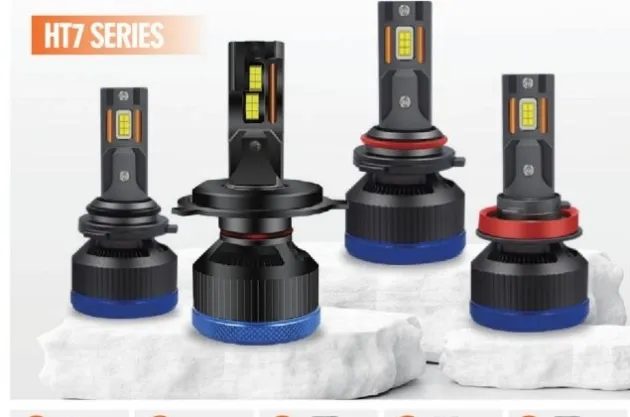
If your LED headlight bulb installs, lights up — and then the dust cover refuses to go back on — the bulb is longer than the space behind the socket, and it is one of the most common LED conversion failures there is. It is a top reason for returns on Amazon, and major retail brands devote a dedicated FAQ section to it ("Why will the dust cover not close?"). The short answer: most LED bulbs carry a cooling fan and driver hardware behind the socket where a halogen bulb has nothing, so they need depth the housing was never designed to give. The proper fix is not force, and it is not leaving the cover off — it is choosing a bulb whose rear profile was designed around the original halogen's footprint: a mini, 1:1-size design. This guide explains the geometry, the risks of the workarounds, how to measure before you order, and the questions distributors should ask any supplier.
Why are LED headlight bulbs longer than the halogens they replace?
A halogen bulb is a glass envelope and a base — everything behind the mounting flange is just the connector. An LED bulb has to move heat away from the LED chips, and it has to convert and regulate power. So behind the flange you will typically find a heat sink, often a small cooling fan, and the driver electronics — either built into the bulb's tail or in a separate external box on a cable. Depending on the design, that stack can extend the bulb's rear length by 20–40 mm or more compared with the halogen it replaces.
Headlight housings, meanwhile, were designed around the halogen. The dust cover sits a fixed distance behind the socket — sometimes generous, sometimes only a few millimetres of clearance. When the LED's tail meets the cover before the cover's threads or clips engage, you have the classic failure: bulb in, cover off, nowhere to put it.
What goes wrong if you force the cover — or leave it off?
Both workarounds create bigger problems than the one they solve. Forcing the cover can crack the cover or the housing tabs, bend the bulb's connector pins, or push the bulb slightly out of its seated position — and a bulb that is not seated exactly where the original filament sat produces a scattered beam pattern and glare, even if it lights up.
Leaving the cover off is worse over time. The dust cover is a seal: it keeps water vapour, dust and road dirt out of the housing. Without it, moisture enters, condenses on the inside of the lens (the fogged-headlight complaint that arrives a few weeks after the install), and dust settles on the reflector or projector lens, permanently degrading output. On some vehicles the open housing also exposes the bulb's fan and electronics to water splash they were not meant to face directly. A conversion that "worked" on day one becomes a comeback, a bad review, or a warranty dispute on day thirty.
If a bulb genuinely cannot fit with the cover closed, the correct move is a different bulb — not a modified housing.
What does "1:1 mini" actually mean — and which SUNRISE bulbs are built that way?
A 1:1 (or "mini") LED bulb is designed so its overall dimensions — critically, the length behind the mounting flange — match the original halogen bulb's dimensions as closely as possible, so it occupies the same space, uses the original connector position, and lets the dust cover close exactly as it did before. "Real 1:1 mini size" has become a headline claim on best-selling Amazon listings for a reason: it is the direct answer to the clearance problem.
At SUNRISE, the mini architecture is the HT8B/HT8S mini family and the HT8 Mini 120W range, which covers H1, H4, H7, H11, 9005, 9006 and 9012 HIR2 in a compact body. Two design notes matter for buyers. First, compact does not mean driverless: the HT series works with an external CANbus decoder where a vehicle requires one, and on tight housings the decoder's placement is part of the fitment conversation — ask before ordering, not after. Second, contrast the D-series architecture: the HTD range for factory HID replacements has its driver built in, so there is no external box to hide behind the cover at all. Different sockets, different architectures — what matters is that the rear profile of the specific bulb fits the specific housing.
How do you measure available depth before ordering?
Five minutes with the original bulb prevents the return. With the halogen removed:
- Measure the space, not the bulb. Insert a ruler or depth gauge through the socket opening to the inside face of the closed dust cover (or to whatever sits behind the socket — some housings have a wall or a wiring loom instead of a deep cover). Note the distance from the socket's mounting face to that obstruction.
- Measure the halogen's rear length from its mounting flange to the end of its connector, for reference.
- Compare with the LED bulb's stated rear length (flange to the end of the tail, including any fan housing). If the supplier's drawing does not state this dimension, that is itself an answer — ask for it in writing.
- Check the cover's shape. Some covers are domed (more room in the centre), some are flat, and some housings use a rubber boot instead of a hard cover. A bulb that fits under a domed cover may not fit under a flat one in a different model with the same socket.
- Test one side first. Fit the bulb, close the cover, and check both the cover seal and the beam pattern on a wall before doing the second side — and before ordering a quantity.
Distributors: build this measurement into your sample process. One golden sample fitted into the two or three most common housings in your market tells you more than a catalogue page.
What should distributors ask suppliers before stocking a bulb for tight housings?
- "What is the rear length from the flange, in millimetres?" A supplier who designs mini bulbs can answer immediately; one who cannot is selling you someone else's guess.
- "Where does the driver live?" Built into the tail, or an external box — and if external, how long is the cable and where do installers in this vehicle class usually place it?
- "Which of my market's common models has this bulb been fitted into, with the cover closed?" Real fitment history beats a generic "fits most vehicles" claim. No bulb fits every vehicle, and a supplier who says otherwise is telling you something about their other claims too.
- "What is your return and warranty handling if fitment fails on a listed application?" SUNRISE backs its range with an 18-month warranty — ask every supplier what stands behind theirs.
FAQ
Can I cut or drill the dust cover to make room?
You can, and some installers do — but you are trading the housing's moisture and dust seal for clearance. If you modify a cover, say so to the customer, and understand the condensation risk is now theirs and yours. The cleaner solution is a bulb designed to fit.
Does a mini bulb mean lower performance?
Not by definition. Output depends on the LED chips and how well heat is managed within the format. What mini changes is the physical envelope. Judge a mini bulb by a fitted sample — beam pattern, cover closure, and behavior after 30 minutes of operation — not by its size.
The bulb fits, but the cover closes only with pressure. Is that acceptable?
No. Pressure on the tail can unseat the bulb or stress the connector, and the beam pattern will tell on it. If the cover does not close freely, the fit is wrong.
What about extended/aftermarket dust covers?
They exist for popular models and can be a legitimate accessory sale alongside a standard bulb. But they add a part, a cost, and a fitment question of their own — for most distributors, stocking a 1:1 mini line is the simpler answer to the same problem.
How do I know if my market's cars have tight housings?
Check the best-sellers in your range: compact cars and models with small engine bays are the usual suspects. If your returns or questions already include "too long" or "cover won't fit," your market is telling you it needs the mini format.
Fighting dust-cover returns on a socket you sell? Tell us the socket and the vehicle models involved — we will match the HT8 Mini configuration, confirm the rear-length dimensions in writing, and arrange samples you can test in the real housing. Contact us through the site or on WhatsApp: +86 173 6284 6689.