
Aug 27, 2026
Aging Vehicle Fleets: What They Mean for Automotive Lighting Distributors
Learn how rising vehicle age can affect aftermarket lighting demand and how distributors can plan LED headlight, projector and auxiliary lighting inventory.
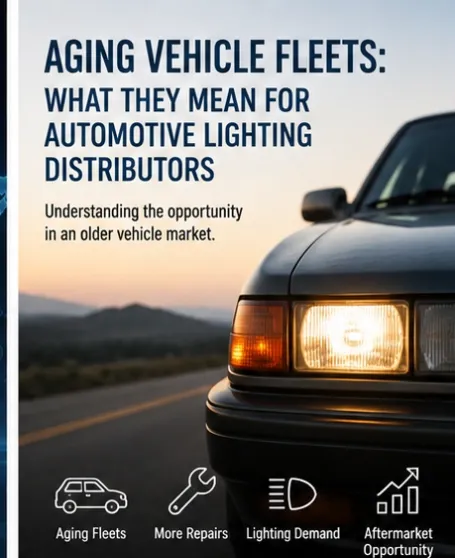
A vehicle does not enter the aftermarket on the day it leaves the factory.
The most interesting aftermarket years often come later.
As vehicles age, owners become more likely to repair, replace and upgrade components instead of relying on original warranty coverage.
That is why average vehicle age is one of the most useful indicators for parts distributors.
Vehicle Fleets Are Getting Older
S&P Global Mobility reported that the average age of vehicles in the United States reached 12.8 years in 2025.
Its broader 2026 aftermarket outlook also shows Europe moving above 14 years average vehicle age.
At the same time, the global light-vehicle fleet continues to expand.
These trends create a large installed base of vehicles that will continue requiring aftermarket support.
For automotive lighting businesses, this matters because lighting is both:
- a replacement category
- an upgrade category
Why the 6–14 Year Vehicle Range Matters
Aftermarket demand often becomes particularly interesting once vehicles move beyond their newest years.
S&P Global Mobility has highlighted the 6–14 year age range as an important window for aftermarket service and repair demand.
By this stage:
- original warranties may have expired
- lamps may have degraded or failed
- owners may be more open to aftermarket parts
- resale vehicles may receive cosmetic or lighting upgrades
This is where independent distributors and repair businesses can become more relevant.
Older Vehicles Often Have More Replaceable Lighting Components
New vehicle lighting is increasingly integrated.
Older vehicle fleets, however, contain huge numbers of cars using replaceable:
- halogen bulbs
- HID/D-Series light sources
- fog lights
- conventional auxiliary lighting
This creates continuing demand for replacement and upgrade products.
For LED headlight distributors, the opportunity is not simply selling the newest technology.
It is understanding the older vehicles that are still driving every day.
Vehicle Age Should Influence Socket Inventory
Imagine two markets.
Market A contains many older Japanese and Korean vehicles.
Market B contains a younger vehicle fleet with more integrated European LED headlamps.
The ideal headlight-bulb inventory may be completely different.
Before buying large quantities of:
H4
H7
H11
9005
9006
or D-Series products,
look at which vehicles are actually common locally.
Historical sales data can be even more valuable than national statistics.
Repair Shops Are an Important Information Source
Wholesalers do not need expensive databases to begin understanding local vehicle demand.
Talk to the businesses already touching these cars every day.
Ask:
- repair shops
- headlight retrofit shops
- accessory retailers
- electricians
- used-car dealers
which lighting products customers request most often.
These conversations can reveal demand that supplier catalogs cannot.
Aging Fleets Create Upgrade Demand Too
Not every lighting purchase is caused by failure.
Owners of older vehicles may also want to improve:
- appearance
- nighttime visibility
- vehicle resale presentation
- accessory functionality
This supports aftermarket categories such as:
- LED replacement bulbs
- Bi-LED projector lenses
- auxiliary lights
- work lights
- light bars
The important thing is matching the product to the customer and market.
Do Not Assume Old Vehicle Means Low-Price Product
Another sourcing mistake is assuming owners of older vehicles always want the cheapest solution.
Some do.
Others may prefer upgrading an existing vehicle because buying a newer vehicle is expensive.
This can create demand for several product tiers:
- value
- mainstream
- higher-performance
A distributor should let real sales data determine the product mix.
Product Availability Becomes Important as Vehicles Age
As a vehicle platform gets older, OE parts can become:
- more expensive
- harder to source
- less attractive relative to vehicle value
This can strengthen aftermarket opportunities.
But only if distributors can provide parts that customers understand and installers trust.
Clear fitment and product identification become essential.
Build Inventory by Vehicle Population
A practical purchasing process is:
- Identify the top vehicle brands and models in your market.
- Identify their common lighting applications.
- Compare this with your historical sales.
- Select core sockets and product types.
- Test representative products.
- Build first inventory.
- Track turnover.
- Adjust future orders based on actual demand.
This is much stronger than choosing inventory by catalog appearance.
Watch the Fleet, Not Just New-Car Sales
Automotive news often focuses on new vehicles.
But the aftermarket lives on the total fleet.
A country may sell many new EVs while still having millions of 10-, 15- or 20-year-old vehicles on the road.
For aftermarket distributors, the installed base matters.
Build a Replacement Lighting Range with Sunrise Auto Parts
Sunrise Auto Parts supplies LED headlight bulbs and automotive lighting products for distributors serving different vehicle fleets and aftermarket segments.
Tell us your market and common vehicle applications, and we can discuss suitable socket and product combinations.
Related Resources
LED Headlight Bulbs: https://www.chuxuparts.com/productsD-Series LED Headlight Bulbs Guide: https://www.chuxuparts.com/posts/d1s-d2s-d3s-d4s-d5s-d8s-led-headlight-bulbs-wholesaleLED Work Lights: https://www.chuxuparts.com/productsHT7 range guide: https://www.chuxuparts.com/posts/ht7-pro-vs-ht8a-vs-ht7-led-headlight-bulbs